
While my guitar gently weeps
Editor’s note: ’Tis the season for the blues. With the dreary mornings and chilly evenings, with the hide-and-seek games of the sun, we find ourselves drifting off into the worlds created by our favourite troubadours. And with the Mahindra Blues Festival—a celebration of the form held in Mumbai each year in February—upon us, now’s as good a time as any for Narendra Kusnur, our favourite music journalist, to dive into the history of this soulful and viscerally expressive sound, and how it came alive.
*****
On the second weekend of February every year, a large bunch makes its way to Mehboob Studios in Bandra, the happening suburb in Mumbai. It’s when the Mahindra Blues Festival (MBF) takes place, and whether they are fans of the genre or not, they go there for the experience. Some go for the music, some for the whisky, some for the food, some to be seen, some to drop names, some for a mix of all. Musically or otherwise, it’s a vibe, as we shall see in the video below.
This year’s MBF on February 14 and 15 is headlined by Britisher Matt Schofield and Americans Eric Gales and Shemekia Copeland. Since the event was launched in 2011, it has featured the legends Buddy Guy, John Mayall, Jimmie Ray Vaughan, and Taj Mahal, and the marvellous artistes Keb Mo, Charlie Musselwhite, Kenny Wayne Shepherd, Ruthie Foster, Susan Tedeschi, and Derek Trucks, besides Indian acts Soulmate, Blackstratblues and Arinjoy Trio. Though old-timers complain that the same musicians are now being repeated, and lesser-known names are increasingly featured, the truth is that this event is much awaited and enjoyed. To check the scene, let’s watch a clip from the 2018 jam session, led by British blues giant John Mayall.
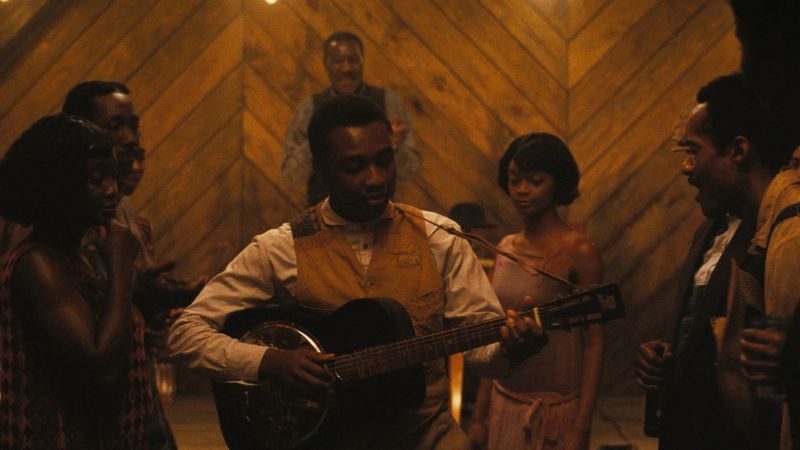
Unlike in the West, half the MBF crowd may not consist of dedicated blues followers. The aim of this column is to give them a basic introduction to the blues, that will spark their curiosity. Let’s start with two movies. The Oscar nominations are due on January 22, and one expects Ryan Coogler’s film Sinners to be named in some categories. The film is available for Jio Hotstar subscribers and can be rented on Prime Video. Though it has been marketed mainly as a horror and vampire movie, it is set in the Mississippi Delta region in the 1930s. The plot has many references to the blues music of that era, and one of its characters is inspired by the legendary artiste Robert Johnson. Music director Ludwig Goransson has already bagged a Golden Globe for Best Original Score – Motion Picture. Here’s actor Miles Caton as an aspiring blues musician, Sammie Moore, singing ‘I Lied To You’ at a juke joint.
The film also features a cameo by Buddy Guy, who plays the same musician after he grows old. Here’s a clip.
The other movie one could check to understand early blues is Ma Rainey’s Black Bottom (2020), available on Netflix. Set in 1927, it’s about the legendary singer Ma Rainey, played by Viola Davis, who has been contracted by white producers to record an album. Let’s see the trailer.
Though these films are set in the 1920s and 1930s, the evolution of the blues began much earlier. The genre is said to have originated among African Americans in southern US in the 1860s, incorporating spirituals, work songs, chants, and ballads. While the guitar is the most dominant instrument, piano and harmonica also play a big part. The music is characterised by a call-and-response pattern, which is like a musical conversation between voice and instrument, the use of blue notes, often played at a different pitch from the standard, and specific chord progressions, the most common of which is the 12-bar blues. These terms may sound complex on first reading, but the more one listens, the more one will understand them. This is what a typical blues number sounds like.
With such an illustrious history, the blues boasts of a long list of legends. As it’s difficult to mention all in a single column, we shall briefly describe the roles played by seven musicians over different periods.
Let’s begin with WC Handy (1873-1958), often described as the Father Of The Blues. Though there is no specific mention of who actually created the genre, Handy was one of the first to publish music in the blues from. From a regional style restricted to the Delta region, he helped the blues reach a new audience with songs like ‘Memphis Blues’, ‘Beale Street Blues’, and ‘St Louis Blues’ in the 1910s. Here’s a rare recording of him singing ‘Memphis Blues’.
The next musician is someone who shaped the future sound of the blues. Robert Johnson (1911-1938) recorded only 29 songs in his brief career, including the iconic ‘Sweet Home Chicago’, ‘Cross Road Blues’, ‘Ramblin On My Mind’, and ‘Love In Vain Blues’. He was a huge influence on later-day musicians like guitarists Eric Clapton and Keith Richards of the Rolling Stones, vocalist Robert Plant of Led Zeppelin, and Bob Dylan. There were several myths about him, including one that said he sold his soul to the Devil in exchange for his guitar. He died at 27, and there were many theories, one of which was that he was given a poisoned drink by the husband of a woman he had become close to. To check his style, let’s hear Johnson’s recording of ‘Sweet Home Chicago’, followed by Clapton’s take in 2004.
Before World War II, the blues world was dominated by men, but some women made a mark with their powerful singing. Bessie Smith (1892-1937) was called the Empress Of The Blues. Her songs were considered path-breaking, as she encouraged working-class women to embrace their right to drink, party, and satisfy their sexual needs as a means of coping with stress and dissatisfaction in their daily lives. Here’s her recording of the blues standard ‘Nobody Knows You When You’re Down And Out’, followed by a contemporary take by the Tedeschi-Trucks Band, featuring vocalist Susan Tedeschi and guitarist Derek Trucks.
If there’s one blues musician who’s influenced an entire generation of rock stars, it’s McKinley Morganfield aka Muddy Waters (1913-1983). Best known for the song ‘Hoochie Coochie Man’, ‘Mannish Boy’, and ‘Rollin Stone’, he was a pioneer of electric blues who influenced the likes of the Rolling Stones (who named themselves after his song), Eric Clapton and guitar god Jimi Hendrix. ‘Hoochie Coochie Man’, written by Willie Dixon, the most prolific and influential blues songwriter, has been recorded by many artists. Let’s check a live recording by Muddy Waters, followed by the rare take by Hendrix.
The other huge influence on modern artists was Riley B King (1925-2015), known professionally as BB King. He specially played a role in the use of the electric guitar in the blues. He also kept experimenting with different types of guitars, which he called Lucille. King played concerts till his late 80s, even appearing at the New Orleans Jazz Festival in 2013, when he was 87. Here’s a 1993 recording from his performance in Montreux, Switzerland.
The musicians mentioned so far are all Americans. One of the British legends to play a major in spreading blues culture was John Mayall (1933-2024). He was the man who invited Clapton to be part of his group Bluesbreakers, and their 1966 self-titled album was a big success. Other guitarists to work with Mayall were Peter Green, who later joined Fleetwood Mac, and Mick Taylor, who became part of the Rolling Stones. Mayall himself sang, and played keyboards, guitar, and harmonica. We’ve already posted a snippet of him at MBF. Here’s an older clip of ‘Rock Me Babe’ he recorded with singer Etta James and guitarist Mick Taylor in 1982.
A list of blues legends would be incomplete without mentioning the person who has almost made Mumbai an alternate home. Born in 1936, American icon Buddy Guy has performed in the city seven times, including five at MBF. Besides numerous solo albums, he’s known for his partnership with harmonica great Junior Wells in the 1960s. He continues to encourage and perform with young musicians, and even released a new album Ain’t Done With the Blues last year. Let’s check a 2005 video of his performance of ‘What Kind Of Woman Is This?’ with John Mayer, who incidentally is performing in Mumbai on February 11.
The above artists act as a good introduction to traditional blues. We conclude the column with a short note on blues-rock, which is what one hears at most festivals these days. As the name suggests, it’s a fusion genre blending the emotional depth and improvisation of blues with the louder, electric instrumentation of rock. After groups like Yardbirds, Cream, and the Animals set the tone in the 1960s, it was taken forward by artists like Clapton, Gary Moore, and Stevie Ray Vaughan, who sadly died in 1990 in a helicopter crash. He was 35. As a finale, here’s ‘Pride and Joy’ from a 1982 concert featuring Vaughan and his band Double Trouble.
From that basic introduction, one hopes readers can begin exploring the vast world of the blues, just in time for MBF. As a recap, here’s a list of songs we featured.
Miles Caton – I Lied To You in the film Sinners
Buddy Guy – Travellin’ in Sinners
W.C. Handy – Memphis Blues
Robert Johnson – Sweet Home Chicago
Eric Clapton – Sweet Home Chicago
Bessie Smith – Nobody Knows You When You’re Down and Out
Tedeschi Trucks Band – Nobody Knows You When You’re Down and Out
Muddy Waters – Hoochie Coochie Man
Jimi Hendrix – Hoochie Coochie Man
BB King – The Thrill Is Gone
John Mayall with Etta James – Rock Me Babe
Buddy Guy with John Mayer – What Kind of Woman Is This?
Stevie Ray Vaughan – Pride and Joy
*****
Narendra Kusnur has been a music journalist for over 40 years—including a decade-long stint covering the beat at the Mid-Day newspaper. He currently writes for The Hindu, Free Press Journal, Hindustan Times, and Rolling Stone India—besides the in-house magazines of prestigious institutions—such as NCPA and Shanmukhananda Hall.
 souk picks