

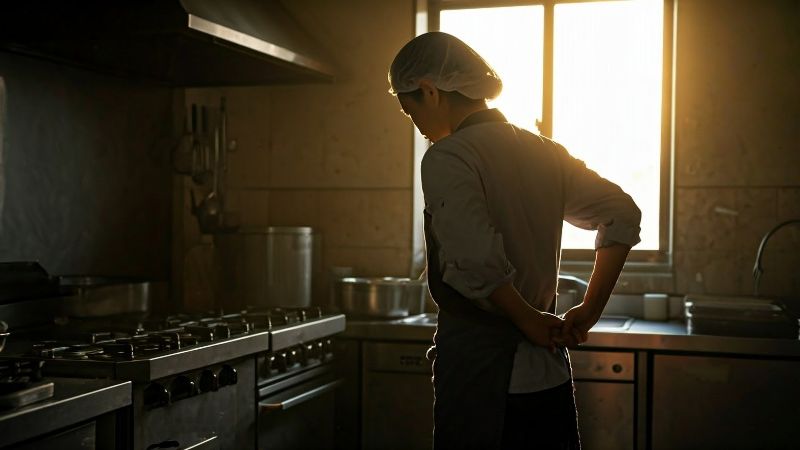
The man behind the apron
Editor’s note: We know Suvir Saran the celebrated chef. A star of the New York food scene. The man behind Devi, the first Indian restaurant in the US to earn a Michelin star. The cookbook author par excellence who strived to bring Indian cooking to American kitchens. But in his emotionally bare memoir, Tell My Mother I Like Boys, Saran digs deeper and shows us his life beyond just the kitchen. He takes us through his journey from India to the US: his drive to succeed, his desire to express, heartbreak and self-discovery, the joy of farming. And his search for acceptance.
In the following excerpt, Saran talks about his restaurant, Devi, receiving a Michelin star, and the hollowness he felt even as his career was thriving. And how Charlie, a man who always saw the very best in him, stood by him through his struggles. This excerpt from Tell My Mother I Like Boys by Suvir Saran has been published with permission from Penguin Random House.
******
Charlie came into my life like a sunrise after a storm. I had barely begun to understand myself when he saw me—all of me. He didn’t flinch at my fractures. He didn’t try to fix me. Instead, he loved me for who I was: unfinished, unresolved but full of possibility. ‘You’re an unwritten story,’ he told me one night as we lay on the couch, his head resting on my shoulder. ‘And I love that. I love that there are still pages to fill.’
With Charlie beside me, I felt something I hadn’t in years—hope. He didn’t judge me for the ghosts I carried. He embraced them, even when I couldn’t. He gave me the courage to share my voice—a voice I had spent a decade refining but had never truly let out. And so, with him as my anchor, I began to build.
The first step was Indian Home Cooking. It wasn’t just a cookbook; it was a declaration. For years, I had been frustrated by the failures of other books to capture the essence of Indian cuisine. Parsley for coriander? An abomination. These books were written for a Western palate that wanted India without its soul. I couldn’t abide that. I wanted to give people something real, something true. Recipes that worked, that resonated, that brought the magic of Indian kitchens into their homes.
I poured everything into that book. Each recipe was a memory, a story, a piece of my past. Stephanie Lyness, my co-writer, became my partner in this endeavour. We spent hours testing, rewriting, perfecting the recipes. We became each other’s therapists, sharing our lives over pots of simmering curry and trays of samosas. The book wasn’t just about food; it was about connection—connecting the reader to the soul of India and connecting me to a part of myself I had almost forgotten.
When the book was released, the world took notice. Starred reviews, features in national papers, cooking schools clamouring for classes—it was a whirlwind. But even as I stood in the spotlight, a part of me remained in the shadows. Success felt hollow when the world celebrated the book but couldn’t see the man behind it. I smiled for the cameras, shook hands at book signings and went home to a mirror that reflected the truth: I was exhausted, disconnected and unsure of what was coming next.
And then came Devi. The restaurant was a labour of love, born from a collaboration with Hemant Mathur and Rakesh Agarwal. Gail Green named it for us, inspired by our vision of serving food that was as nurturing as a mother’s love. From the outset, I knew Devi would be more than a restaurant. It would be a statement. A rejection of the word ‘ethnic’ and all its connotations. Our food wouldn’t just be Indian; it would be art.
Opening Devi was chaos and creation all at once. We transformed the space with fabrics and antiques, weaving a story into every corner. I trained the staff to know not just the dishes but their histories, to share not just menus but memories. We plated food on hand-crafted Japanese pottery, each piece chosen with care. Nothing was accidental. Everything was deliberate. And when the doors finally opened, the world came rushing in.
Devi was an immediate success, but the pinnacle came with the Michelin star. The first Indian restaurant in America to receive one. The first non-Northern European restaurant to break through that barrier. It was validation of everything we had worked for. And yet, when the call came, I felt . . . nothing. Charlie noticed, of course. He always noticed. ‘Babe,’ he said, his voice soft, ‘what’s wrong? This is huge.’
‘I’m fine,’ I said, smiling. But I wasn’t. The truth was, the star felt like another shackle. Another expectation. Another layer of pressure on a life already stretched thin.’
Charlie tried to bridge the gap, showing up at the restaurant after his long days, charming customers, being my rock. But our time together was fleeting, stolen moments between shifts and obligations. I was losing myself to the demands of success, and in the process, I was losing him too.
The mirror became my confidant again. It never lied. It showed me a man celebrated by the world but hollow inside. A man whose health was deteriorating, whose relationships were strained, whose soul was tired. I had everything I had ever dreamt of, and yet I felt like I had nothing at all.
By the time I wrote American Masala, I had learnt how to navigate the rhythms of fame, but the cost was becoming clear. The book, like the first, was a success. But the more accolades I received, the further I felt from the boy who had arrived in New York all those years ago. The boy who had dreamt of love and belonging, not just success.
*****
This excerpt from Tell My Mother I Like Boys by Suvir Saran has been published with permission from Penguin Random House.
 souk picks