

How Spanish football conquered desi hearts
Editor’s note: A decade ago, José Antonio Cachaza—a football executive from Spain—arrived in India with no clue what to expect. He was here to increase the profile of La Liga, Spain’s national football league featuring global powerhouses such as Real Madrid, FC Barcelona, and Atlético Madrid. Over the next seven years, Cachaza responded to the unique challenges that India, a “chaotic, multicoloured universe”, threw at him, growing to love the country and its peculiar rhythms. Breaking Into Cricketland is his love letter to the country: a memoir detailing his experiences of living in Delhi and learning the cultural beats and norms that define India, and in the process expanding Spanish football through fan engagement and smart maneuvering.
In the following excerpt, Cachaza writes about traditional football centres in a cricket-mad country, as well as urban centres that have embraced club football thanks to the rise of the English Premier League as well as La Liga. This excerpt from Breaking Into Cricketland by José Antonio Cachaza has been published with permission from TWAGAA International.
*****
However, the growth of football as a business in India is concentrated more on large metropolitan areas than on its traditional markets. Football is gradually gaining popularity among the urban middle and upper classes, among whom football already has similar levels of awareness as cricket. I do not mean that it is yet as popular as the national sport, but the younger generation already views it as an aspirational sport that they follow with passion.
In a way, cricket symbolises what India is, while football embodies the aspirations of the new India. Essentially, cricket signifies the traditional India, insular and rooted in its vast market, which maintains certain longstanding ties with the old metropolis and its Commonwealth.
Football, for its part, symbolises India's aspiration not only to integrate but also to take a leading role on the global stage. This aspiration aligns perfectly with a new generation educated with an international outlook, many of whom attend European, Australian, and American universities, and stay connected online with the rest of the world.
That's why we conducted most of our work in Delhi, the political and administrative capital, and Bombay, the economic and entertainment capital, with less work in Bangalore, the technology and digital hub. The pursuit of corporate relationships is central to our work; however, audience data also supported our focus on these regions. The state where LaLiga matches are most watched is Maharashtra, clearly affected by the large number of fans in the Bombay-Pune conurbation, followed unsurprisingly by West Bengal (Kolkata), Kerala, and Delhi.
In traditional football regions, local teams have, as we have seen, large and loyal supporters. This is particularly true in Calcutta (Mohun Bagan, East Bengal, and, to a lesser extent, Mohammedan) and Kerala (Kerala Blasters and even Gokulam Kerala of Calicut, at the time of writing in the I-League, the second tier of local football), but also in Goa (FC Goa). In the Northeast, the situation is a little more complex.
Northeast United, which competes in the Indian Super League (ISL), plays in Guwahati, the entry city to the region, but it is less passionate about football than in other states such as Meghalaya and Mizoram, whose leading teams, Shillong Lajong and Aizawl respectively, compete in the I-League. Major metropolises are hubs of international football, where prominent European clubs even boast fan clubs. The capital once hosted one of the ISL's founding clubs, Delhi Dynamos, but both attendance and institutional backing were minimal, leading the franchise to eventually relocate to Odisha.

Not surprisingly, I recall attending one of their matches with fewer than a thousand fans, who were nearly invisible in the vast 50,000-seat J.L. Nehru Stadium. Bangalore stands apart. The first football match I saw in India was between FC Bengaluru and East Bengal, both now part of the ISL but then in the I-League. I was amazed by the lively atmosphere created by almost twenty thousand enthusiastic local supporters.
Indians prefer to enjoy quality products, and this sentiment extends to football. This is evident in the popularity of the World Cup. Since cricket is historically a sport played by national teams and celebrated for national heroes, the context of the World Cup resonates with them. Consequently, in Kerala and Bengal, Brazil and Argentina have maintained large followings since the Pele and Maradona eras, a trend that has been amplified in Argentina with Messi.
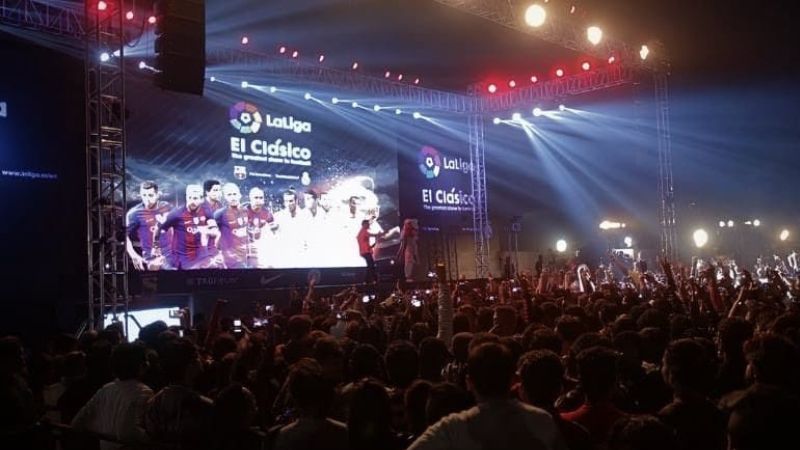
The new generations follow the European leagues and the Champions League, whose winter games start at half past one in the morning local time. I rarely stayed up to watch them, but usually the next morning, I found myself in the office with kids who had stayed up all night to watch football. In this context, thanks to regular surveys and television audiences, we know that the three most followed clubs in India are FC Barcelona, Real Madrid, and Manchester United. Regarding the Spanish clubs, the Catalan team remains more popular than its Madrid counterpart. I'm sure Messi has something to do with this.
It is evident that the English Premier League is the most popular international league among fans in India. The English began promoting their football in Asia three decades ago, which has helped them build a loyal fan base. LaLiga must compete with this, although it has strong contenders, especially from Real Madrid, FC Barcelona, and increasingly, Atlético de Madrid, Sevilla FC, and other clubs.
However, our starting point was not ideal. For example, fifteen years ago, LaLiga matches were not televised in India. Moreover, LaLiga only began to develop an international strategy in 2013, with Javier Tebas assuming the role of president. He based his management model on four strategic axes: centralised sale of audiovisual rights, economic reorganisation and control, digitalisation, and internationalisation. In this context, LaLiga identified India as one of its key markets, which is why it opened its office there in 2017. With this lack of prominence, coupled with clear positioning issues, we started our work in the subcontinent.
That India is a cricket country is evident in the fact that cricket makes up nearly 90 percent of the television viewing audience, not to mention its dominance in the rest of the media and cyberspace.
Football is increasing in popularity and is now the second most-watched sport in India. The most followed league is clearly IPL cricket, closely followed by ISL football and PKL kabaddi, a very popular team sport in North India. Headlines often claim that kabaddi is the second most-watched sport, but this is incorrect. While it is true that in some years, the PKL's viewership has been slightly higher than that of the ISL, when the viewership of international football and other local competitions is included, football clearly remains the second most-watched sport.
*****
This excerpt from Breaking Into Cricketland by José Antonio Cachaza has been published with permission from TWAGAA International.
 souk picks