

Written by: Aarthi Ramnath, Raghav Bikhchandani & Yash Budhwar
Our daily list of Souk picks
Editor’s note: As you may have noticed, we just unveiled a beta version of Souk—which has one simple goal: To help you find unique, high quality products that are worth your time and money.
One: We’ve been trying to eat more greens—especially at dinner—but keeping them fresh felt like a full-time job. Enter the salad spinner. It’s not just for rinsing before you toss a salad. We now wash a whole bunch of leaves in one go, spin them dry (this one really gets the moisture out), and store them in a box layered with paper towels. They stay fresher, longer—and it makes those weeknight meals a whole lot easier. This one’s stainless steel, so it looks good, feels sturdy, and isn’t something you’ll need to replace anytime soon.
Two: We’re not big on delicate messaging, and some statements don’t need subtlety. This F* the Patriarchy Necklace says what needs to be said—clearly, boldly, and in gold. It’s the kind of piece that doesn’t just finish an outfit—it starts conversations (or ends them, depending on who’s asking). Wear it solo or layered, loud or low-key—it carries its own weight either way.
Three: Storage doesn’t have to be boring. This Iris Bloom Basket Set by Bottega Pereira proves the point—it’s practical enough to hold the everyday chaos (onions, keys, mail, you name it) but pretty enough to leave out in plain sight. Handwoven, sturdy, and cheerful, they’re the kind of pieces that brighten up dull corners. The best part? They make organising feel less like a chore and more like a little everyday upgrade.

PS: This is a beta launch and feedback—good or bad—is key. So please email the team at dearsouk@splainer.in with your thoughts. We want to get this right!
Meeting Putin: The clown circus of Trump diplomacy
He came, saw, conquered: Donald Trump met Vladimir Putin in Alaska for a grand summit that was expected to produce a ‘beautiful’ ceasefire. What we got instead was a hastily called press conference after a meeting that lasted less than three hours. Putin basked in the photo-op—and White House validation—while Trump blessedly (astonishingly) didn’t have a word to say. This photo kinda sums it up:
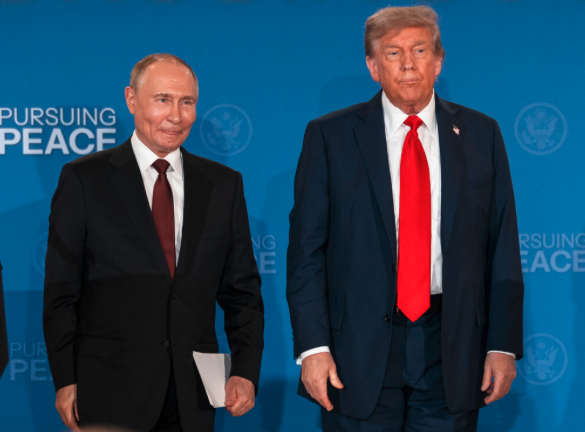
Peace Agreement ahoy! For a brief moment, the US media held on to the hope that their president had not rolled over and played dead for the Russian bear. Sadly not. Soon enough Trump said that “a mere Ceasefire Agreement” was no good—what Ukraine really, really needed was a “Peace Agreement” (in all caps, of course). And how would we achieve this miraculous agreement?
Mr. Trump told European leaders that he believed a rapid peace deal could be negotiated if Mr. Zelensky agreed to cede the rest of the eastern Donbas region to Russia, even those areas not occupied by Russian troops, according to two senior European officials briefed on the call.
Ukraine gives up its land, and Moscow will give… “In return, Mr. Putin offered a cease-fire in the rest of Ukraine at current battle lines and a written promise not to attack Ukraine or any European country again.” A written promise. What more can a girl ask for?
About that Donbas region: It is the Russian-speaking region on the Ukraine-Russia border—which Moscow has long claimed as its own. In 2014, Putin sent troops to take control of the region—and annexed the critical port of Crimea. Now, he wants the rest—and is close to getting it:
Since the full-scale invasion, the Donbas has been the site of the war’s deadliest battles, and is the main focus of Russia’s summer offensive. The Kremlin’s forces and its separatist allies have conquered about 87 percent of the Donbas since 2014, according to data from DeepState, a Ukrainian group that tracks battlefield developments. Russian forces are now chipping away at the 2,600 square miles of the region that remain in Ukrainian hands with very heavy losses.
That’s about 20% of Ukraine itself. You can see the state of play in the map below.
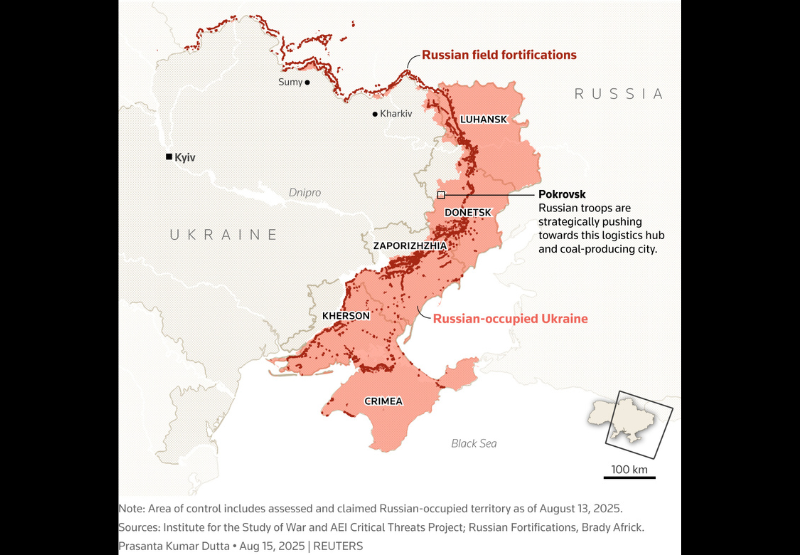
Ceasefire vs Peace: The distinction is critical to Kyiv—one will cede its territory, the other offers a reprieve:
With Russia’s recent advances on the battlefield, a cease-fire would give Ukraine relief from attacks and deprive Mr. Putin of some leverage at the bargaining table. Without a cease-fire in place, Russia can continue the war — in which it has the upper hand. The Russian Army has driven a wedge into Ukrainian defenses in the east, and Ukrainian officials have warned that Moscow has massed forces and equipment for new offensives.
What’s next: President Zelenskyy is off to the White House—but this time he’s accompanied by a posse of European leaders, including Emmanuel Macron, Keir Starmer, Giorgia Meloni, Friedrich Merz and EU chief Ursula von der Leyen. It isn't clear whether they can change Trump’s mind—but at least bechara Zelenskyy won’t be yelled at in front of the world… we think.
The big picture: Trump only understands and respects power. As he put it bluntly, “Russia is a very big power, and they’re not”—and Kyiv just has to accept its place as the runt in Russia's wolf pack. Zelenskyy has refused to cede an inch of territory—with the backing of the EU. But guess who is every bit as good at buckling at critical moments—the Europeans (see the tariff badnaami).
Reading list: New York Times (splainer gift link) is best on why Putin wants Donbas—and Russia’s history with Ukraine. Reuters reports on the Alaska meeting with Putin—and Politico has more analysis on his diplomatic win. NBC News has the most on the scramble by Ukraine and its European buddies to regroup.
Pakistan drowns in flash floods… again!
At least 194 people died in flash floods in Pakistan in a single day—due to a massive cloudburst on Thursday. The death toll as of Saturday: 300-plus. Most of them died in the northwestern region of Khyber-Pakhtunkhwa. Entire villages and roads have been washed away. And the rescue efforts have been fraught:
Rescue teams tried to reach flooded areas by air, on foot and via heavily damaged roads. A helicopter that was on its way to deliver relief supplies crashed because of the bad weather, killing five crew members.
At least 500 people have died due to the monsoons in Pakistan this year—and 700 injured. This is the worst affected district—Buner:
Reminder: In 2022, vast swathes of Pakistan were devastated due to what UN Secretary General António Guterres described as “monsoon on steroids.” Nearly 1,400 people died, 33 million people were displaced, and a third of the country was under water.
What happened? Cloudbursts, as usual. These sudden deluges—also called ‘rain bombs’—have caused catastrophic damage in India as well. They are common on both sides of the border—because cloudbursts “thrive in moisture, monsoons and mountains.” Basically, clouds containing vast amounts of moisture are forced upwards by the mountains—where they cool, condense and pour down.
They are becoming more frequent due to climate change:
The frequency of cloudbursts in these two South Asian nations has been steadily rising due to a warming atmosphere, because a warmer air mass can hold more moisture... from the Arabian Sea and Indian Ocean, and that rain then tends to get dumped all at once. It means the monsoon is punctuated with intense flooding and dry spells, rather than sustained rain throughout.
Reading list: The Guardian is best on the floods in Pakistan. The Independent is best on cloudbursts. CNN has more data and pictures of the natural disaster. BBC News has the latest updates.
Israel’s got a brand new plan… for ethnic cleansing
Plan A: Since the start of the invasion of Gaza, Bibi Netanyahu has been trying to expel its residents from their land—with the enthusiastic support of Washington. He calls it “resettlement”—the world calls it “ethnic cleansing.” But until now, its Arab buddies Egypt and Jordan—which border Gaza—have been unwilling to play ball. The reason: Neither dictatorship—already short on legitimacy—wants over a million disaffected Palestinians on their soil.
Plan B: The always flexible Bibi has, therefore, been floating the idea of a “humanitarian city”—i.e. a concentration camp that corrals the entire populations inside a very small area.
Plan C: According to the Wall Street Journal, Tel Aviv and Washington are now looking for new destinations for expelled Palestinians:
The countries involved are South Sudan, Somaliland, Ethiopia, Libya, and Indonesia, a senior Israeli official told CNN. In exchange for taking in some of Gaza’s population of more than two million people, the official said the countries are looking for ‘significant financial and international compensation.’
The selection criteria: The list isn’t quite as random as it sounds. South Sudan is eager to rebuild ties with Washington—and has already taken a number of US deportees—almost none of them are Sudanese. Others want the US to legitimise their own illegal annexations:
In February, Hebrew news outlet Channel 12 reported that Morocco, the Puntland State of Somalia, and the Republic of Somaliland are being considered as places to relocate Palestinians as part of Trump’s controversial plan. Puntland and Somaliland seek international recognition of their sovereignty over Somali territory, while Morocco seeks recognition of its sovereignty over the occupied Western Sahara.
Libya is broke and desperate for US aid. So is Syria—whose new leader has recently wormed himself into Trump’s good books.
The big picture: The big bullies—Bibi and Donald—are trying to do an end run around Arab states. They have blocked all efforts to displace Gazans—content to leave them to starve in place instead. We leave you with Wall Street Journal mulling the tricky ‘legal’ issues involved in the proposed ethnic cleansing:
Forcible displacement is a crime under the Geneva Conventions, to which Israel is party, and is permissible only in narrow circumstances such as temporary evacuation for civilian safety or military necessity. The bar for meeting those criteria is high and Gaza’s war-torn environment complicates arguments that transfers would be voluntary, Israeli and international legal experts said.
CNN has more reporting if you need it.
MAP Academy & Nalli Fellowship is now open!!
Editor’s note: As you know, the wonderful MAP Academy is our content partner for Advisory. It is one of the few Indian institutions deeply invested in cultural research and education. They also offer rare funded opportunities for researchers, designers, archivists, journalists, writers and educators. The Nalli Fellowship is one of them.
Over to MAP Academy…
Are you working on the histories and practices of South Asian textiles and their socioeconomic, environmental or cultural implications?
The MAP Academy & Nalli Fellowships is offering four Research Fellowships of Rs 5.5 lakh each, for the study of textiles from India, Pakistan, Bangladesh, Bhutan, Tibet, Afghanistan, Myanmar, the Maldives, Nepal, and Sri Lanka. Applications are welcome from individuals—students, journalists, educators, designers, researchers—as well as from collectives and non-profit organisations. The grant must be used to support one year of research, which may be part of a longer-term project.
Applications will be assessed by an Advisory Committee, based on the responses in the submitted form, which will also double as the project proposal. Shortlisted applicants will be interviewed via an online video call, after which a final selection will be made.
Applications will remain open until October 15, 2025.
Find out more, and apply through this link. For any queries, contact us at: fellowships@map-india.org.

what caught our eye
business & tech
- New data shows the ChatGPT mobile app has hit 690 million downloads worldwide and pulled in $2 billion in revenue—leaving rivals far behind.
- The Information reports that Meta is reshuffling its AI strategy for the fourth time in six months, splitting its new Superintelligence Labs into four teams covering products, infrastructure, long-term research, and a still-to-be-decided unit.
- Anthropic says its newest Claude models can now shut down conversations in rare cases of persistent abuse—not to protect humans, but to protect the AI itself.
sports & entertainment
- Terence Stamp—the iconic face of 1960s British cinema who later reinvented himself in films like 'Superman', 'Priscilla', 'Queen of the Desert' and 'The Limey'—has died at 87. The Guardian has a tribute to the "mesmerisingly seductive dark prince of British cinema."
- Actress Shwetha Menon has become the first woman to head the Malayalam film body AMMA after a bitterly contested election marred by allegations and an FIR over her past films.
- The Conversation has a good read on how Premier League kit colours—from bold reds to dull greys—may actually influence how teams perform on the pitch.
- World number one Jannik Sinner will meet rival Carlos Alcaraz in their fourth final of the season after both cruised into the Cincinnati Open title clash with straight-set wins.
- BCCI will roll out a new “serious injury replacement substitute” rule in multi-day domestic tournaments this season, starting with the Duleep Trophy.
- Neeraj Ghaywan’s drama ‘Homebound’, starring Ishaan Khatter, Vishal Jetwa and Janhvi Kapoor, has swept the Indian Film Festival of Melbourne 2025, winning best film and best director.
- Indian Express has a good read on how 'Coolie' and 'War 2' reveal the emptiness of the Pan-India dream, with both directors cramming in elements till the very end to mask the fact that nothing meaningful is really at stake.
health & environment
- Global negotiations to end plastic pollution through a landmark treaty have broken down, with over 100 nations pushing to curb production while oil states insist on recycling instead.
- South Africa will review its cheetah translocation project in India and weigh the science before allowing any more exports.
- Scientists have found that keratin—the protein in hair, skin, and wool—can actually repair tooth enamel and may protect against decay better than fluoride toothpaste.
meanwhile, in the world
- Trump has announced plans to impose tariffs on imported steel and semiconductor chips in the coming weeks.
- The US has halted visitor visas for Gazans after right-wing backlash, cutting off a route for even sick children seeking medical care.
- India is ramping up ties with China and Russia as Jaishankar heads to Moscow and Wang Yi lands in New Delhi—just as trade tensions with the US deepen.
- The Trump administration has backtracked, keeping DC’s police chief in charge even as Attorney General Pam Bondi orders the local police force to work with federal immigration authorities.
- Scientists at UC Berkeley have coined the term “doubling-back aversion” to explain why our brains often refuse to take the easier route if it means "retracing our steps".
meanwhile, in India
- Mid-day has a horrifying read on how female students in Mumbai’s college festival committees are facing rampant sexual harassment, with some even being threatened with rape.
- Two investigations into alleged electoral scams reveal shocking irregularities—fake voter registrations on non-existent addresses in Bihar and major procedural lapses in Maharashtra’s 2024 Assembly polls.
- India has quietly blocked Linktree—the popular “link in bio” tool used by influencers, companies, and even political parties like the BJP—though no reason has been given for the move.
- No skeletal remains have been found at 17 dig sites in Dharmasthala despite a man’s claims of burying multiple bodies there between 1995 and 2014, and the case has set off a political storm in Karnataka.
- Economic Times has a good read on how India is mapping fresh rare earth hotspots—from Arunachal’s Papum Pare to Singrauli in Madhya Pradesh—as it scrambles to cut reliance on China.
Four things to see
One: For the first time ever, scientists have recorded an embryo being implanted into a synthetic uterus—to demonstrate how the process occurs. Apparently, the human embryo is pretty aggressive—and “will dig a hole, penetrate, and it will sort of bury itself inside and then start growing.” These experiments will help explain why embryos fail to implant—causing 60% of miscarriages. See the video below. (Gizmodo)
Two: Late night host Seth Meyers has found the winner of the Andy Samberg lookalike contest: Girish Kumar Taurani. Btw, Samberg is a well-known comedian, while Taurani is a Bollywood dropout. Watch the amusing segment below.
Three: This is the first look of the Bollywood parody series ‘The Ba***ds of Bollywood’—which marks the debut of SRK’s son Aryan Khan. The series is set to drop on August 20, on Netflix. Check out the totally filmy video below. (Hindustan Times)
Four: In memory of Independence Day, here is singer Annu Kapoor’s mashup of ‘Munni Badnaam’ and ‘Vande Mataram’—which is every bit as terrible as it sounds. Nope, nothing is sacred. See the vid below.
feel good place
One: Imagine ‘Mile sur mera tumhara’... in a language war zone.
Two: The elephant family hug! Ridiculous.
Three: George Clooney may be a silver fox. Pamela Anderson is a silver queen.

 souk picks