

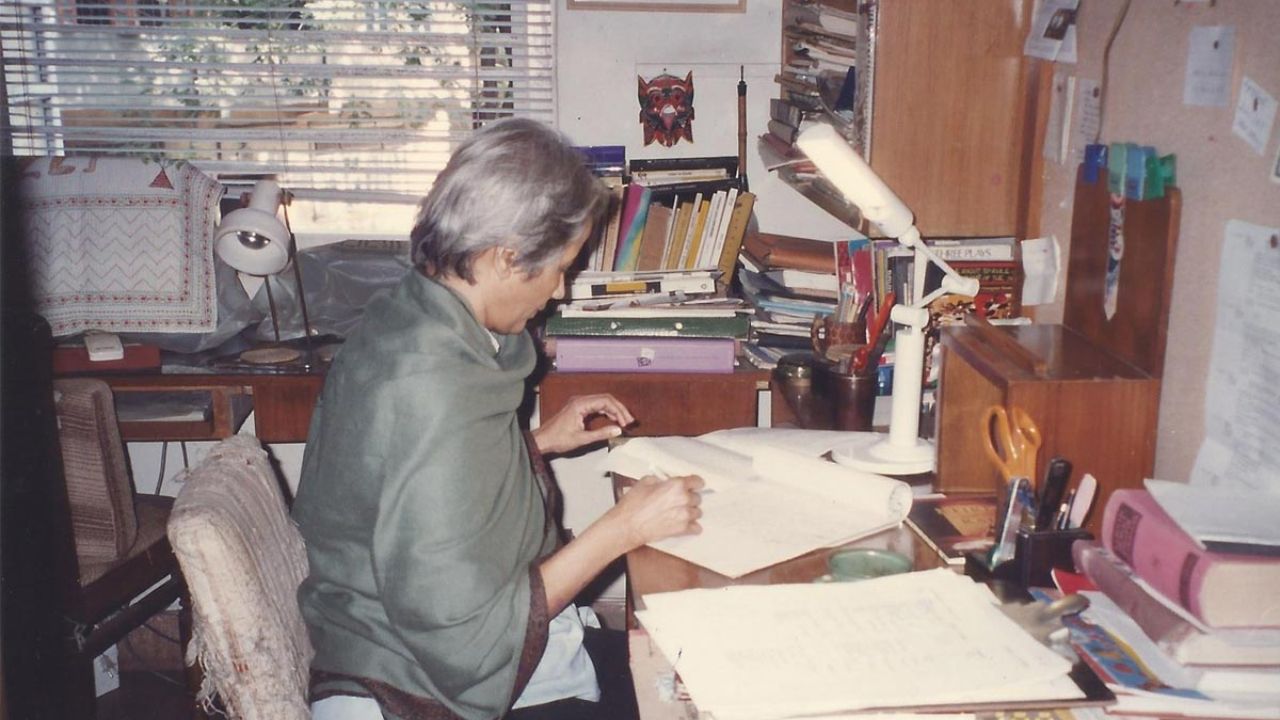
Shanta Gokhale, theatre, existentialism
Editor’s note: Shanta Gokhale, much loved in the literary community, is a writer, journalist, translator, and theatre critic whose work in both Marathi and English has been widely recognised. In her newest book, Of Ancestors and Friends, she allows readers a peek into her life as a writer, taking us through her relationships with books and writers.
Here, she unravels the philosophical musings of Jean-Paul Sartre, existentialism, and his play ‘No Exit’, which she got to experience in India in the ’60s via Urdu adaptations. This excerpt from Of Ancestors and Friends by Shanta Gokhale has been published with the permission of Speaking Tiger.
*****
Yes indeed. Jean-Paul Sartre was icon and friend to everybody in my generation—one that came to adulthood in the late fifties and sixties. I confess I struggled to understand his philosophy while being convinced it held something life-changing for me. I was not alone in my belief. Our entire generation, known to non-readers and non-thinkers as pseudo-intellectuals, was reading him, trying to assimilate him, and striving to live by his philosophy. But Sartre, like every other human being who has given us her/his truth about life, its purpose and meaning, was, with all that, a man of his times. A couple of generations down the line, Sartre became history. What was passed on of his philosophy to later generations was the word ‘existentialism’. By the eighties, the word was being used in popular parlance by people who had just about heard of Sartre, never read him. Out of sheer curiosity I went to the web-based Urban Dictionary, certain that it would have noted the common urban usage of the word. Sure enough, the dictionary has this definition to offer:
‘Existentialism’: ‘You can use this word in pretty much any context and it will make you sound pretentious and/or confuse the person you’re talking to. It’s a technique refined and highly over-utilized by pseudo-intellectuals.’
The dictionary adds examples of such use for our further edification:
‘Thoughts of existentialism breezed through my cavern of a mind as I walked under the concave arches in the courtyard of my prestigious university.’
‘There I was, caught in an existential dilemma. I decided to run the red light.’
‘I felt that the existentialist undertones in the Simpsons represented the decay of religion in society.’
Besides pseudo-intellectuals, troubled souls of all shades began to be diagnosed by friends and well-wishers as being full of ‘existentialist angst’.
Hollywood tried to put the word back in its original philosophical frame in its characteristic comic-sentimental style in the 1993 comedy Groundhog Day, pointing both to Sartre’s Existentialism is a Humanism and Camus’ Myth of Sisyphus. The film takes us through a television weatherman’s process of creating his ‘essence’ as defined by Sartre. Covering the annual Groundhog Day on February 2, in Punxsutawney, Pennsylvania, he is trapped in a surreal time loop which forces him to live through February 2 repeatedly. Consequently, he is assailed by a sense of freedom from all restrictive moralities. He expresses his new-found freedom first through brutal acts of destruction which then lead to introspection. Soon he discovers love which leads him to overcome nihilistic despair and choose to express his freedom in acts that enforce life.
But all this was later. In the sixties, if you weren’t reading and thinking Sartre, you were not worth looking at.
I struggled through Being and Nothingness, catching only the gist now and again. But Sartre’s Roads to Freedom trilogy—The Age of Reason, The Reprieve and Iron in the Soul—was another matter. It was powerful enough to hold me, was probably significant and told a story that I engaged with. I am tentative because I have never gone back to the trilogy again. But it was interesting to learn later that it was actually planned as a quartet. Sartre did not get around to finishing part four because, as he said, he had recognized the basic problem in writing autobiographical fiction which was that it straddled two distinct forms of writing, in which fact and fiction often refused to be bedfellows. His second reason was that he found writing plays more satisfying because they depicted human beings in action. History has endorsed his decision to write plays, at least as far as No Exit goes. Although the novels were received with great enthusiasm in France, while the rest of the world read them because they were written by the author of Being and Nothingness, which had introduced them to existentialism, the philosophy of their times, they were written largely in response to World War II and the occupation of France. Nobody talks of them now, while No Exit is still performed across the world.
In 1965, we saw Mumbai’s most talked about Urdu version of the play directed by the brilliant Satyadev Dubey featuring a cast of young actors who were to become theatre celebrities later—Sulabha Deshpande, Alaknanda Samarth, Amrish Puri and Dubey himself. Dubey was passionately faithful to Sartre’s text including its title Huis Clos (Behind closed doors), translated as Band Darwaze (Closed doors). Perhaps the quality of the performances in his production is most vividly captured by London-based Samarth in the book I have edited on Dubey’s work.
‘There were untold contradictions. It was a tightrope without a safety net. There were struggles during rehearsals. Sulabha is a gracious lady. Wearing Western clothing made her vulnerable. She translated it into a ferocious performance, a new brand of realism. Amrish always struck the equitable balance, with that voice of God—or was it the Devil? Or are they the same in the context of the play? The impact was a bombshell, a slap in the face. Complacency was shattered. Our Band Darwaze in 1965, created overnight, a new audience.’
That was not the last production of No Exit that we saw in Mumbai either. An impressive production was staged in the early 1990s by a young group from Nagpur for whom it was the first attempt to get a foothold in the city and its theatre world. The young actor who played the valet was the only one I have ever seen who kept his eyes wide open, without once blinking, through all his entries. The valet’s eyelidless eyes are an important symbol in the play.
The line from this claustrophobic play that sums up Sartre’s philosophical intent has, perhaps for that very reason, rarely carried the weight of its significance in performance. Although ‘Hell is other people’ carries the very essence of Sartre’s philosophy, placed as it is between two silences, much like a central image against negative space in a painting, it is not always given that weight in performance. It is an utterance of quiet despair, Garcin’s awakening to the truth of human life when knowing it is of no use to him. It is too late. He is dead. His only response to the knowledge now is laughter.
*****
This excerpt from Of Ancestors and Friends by Shanta Gokhale has been published with the permission of Speaking Tiger.
 souk picks