
A legend and his shehnai
Editor’s note: This week, we celebrate the great Ustad Bismillah Khan, forever remembered for his evocative playing of the shehnai by the banks of the Ganga. In this captivating essay, Narendra Kusnur takes us through his life’s work, as well as the journey of the shehnai and its south Indian counterpart, the nadaswaram, in popular culture and beyond.
And as always, we have a playlist with all the songs mentioned in this article, just for you.
Written by: Narendra Kusnur
*****
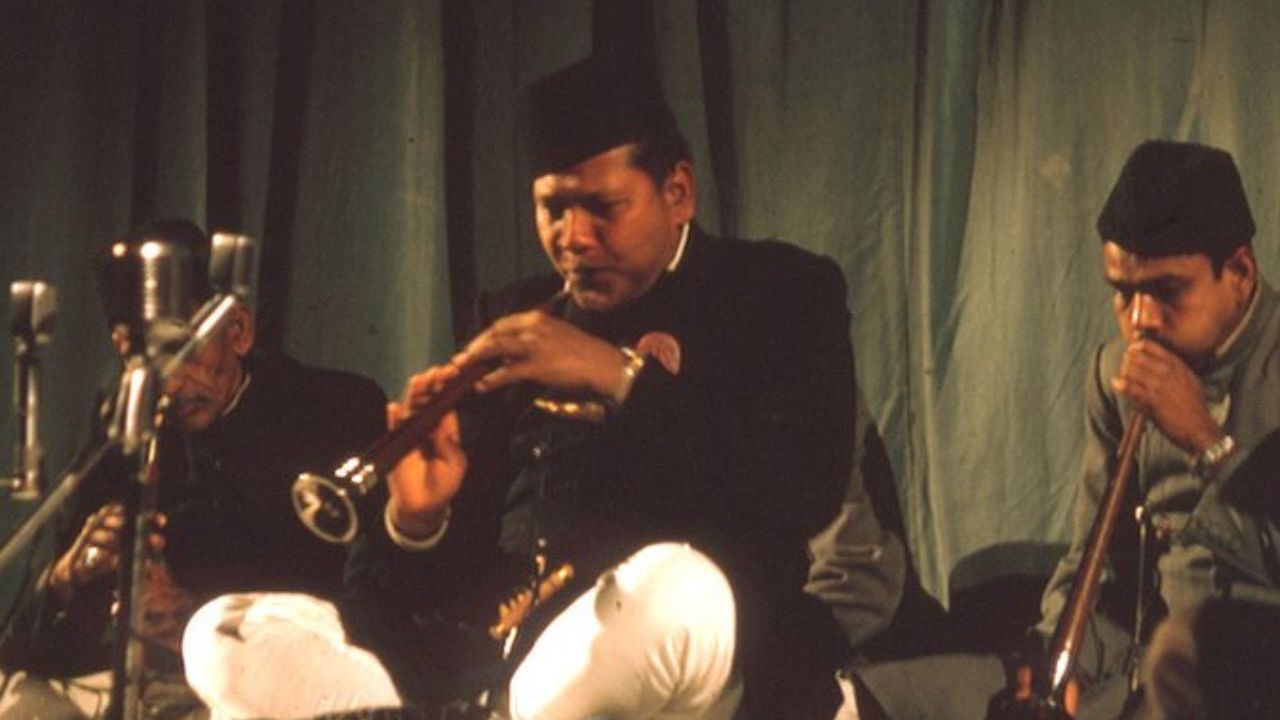
When one talks of the shehnai, one name immediately comes to mind. For over seven decades till he passed away on August 21, 2006, and even much after, Ustad Bismillah Khan has been single-handedly identified with this wind instrument, making it popular in Hindustani classical music and elevating it to concert stage status. Khan was a recipient of the Bharat Ratna, India’s highest civilian honour, and his records were, and still are, compulsorily played on auspicious occasions like marriages and religious ceremonies. Let’s begin with his famous tune in raag Malkauns.
While the maestro’s legacy stays on, the news that his ancestral house in Varanasi is being demolished has caused a lot of distress among fans. The 90-year-old structure is being pulled down for reconstruction, and people are lamenting the loss of another physical link to the city's rich cultural past. It has once again brought into focus the conflict between redevelopment and heritage conservation.
The Varanasi Development Authority has clarified that the demolition is being undertaken by the family and not the administration. Khan saab’s grandson, Mohammed Sibtain, said the house was in a dilapidated condition and the family decided to rebuild it. He maintained that the family plans to establish a museum dedicated to him. Only time will tell what the eventual outcome will be. But one hopes recordings like this one in raag Bhimpalasi are regularly played on the new premises.
Thanks to Khan, the shehnai is immensely popular in north India. But in south India, a similar instrument—nadaswaram—is played, again mainly on auspicious occasions and in temples. Both belong to the family of double reed instruments, and are made of wood, with a metal bell at one end. However, the nadaswaram is much longer, and even louder. In fact, it is considered to be the world’s loudest non-brass acoustic instrument. Let’s listen to the nadaswaram, played by MPN Sethuraman and MPN Ponnusamy in the song ‘Nagamomu Ganaleni’ from the 1968 hit Tamil film Thillana Mohanambal. It was picturised on legendary actor Sivaji Ganesan, with heroine Padmini.
This essay shall discuss both instruments separately, and mention the main musicians playing them. But before that, we shall try and figure out what reed instruments are. Reeds are thin strips which vibrate to produce sound, and can be classified into single reed, double reed or free reed.
In a single reed, one piece of cane vibrates against the mouthpiece, whereas in a double reed, two pieces vibrate against each other. In a free reed, which need not necessarily be found in wind instruments, sound is produced when air passes a vibrating reed in a frame.
Single reeds are mostly used in saxophones and clarinets, whereas double reeds are found in the oboe, bassoon, English horn, the European woodwind shawm, and the Arabic mizmar, besides the shehnai and nadaswaram. There is also the folk instrument ‘been’ which has two pipes fitted with double reeds. It is associated with streetside snake charmers, and is not played in classical music. Free reeds are used in various global folk instruments, and also in the harmonica, accordion, and harmonium. Here, let’s listen to the clarinet, played in the jazz number ‘Stompin At The Savoy’ by the popular Eddie Daniels, and the Arabic mizmar, played by the Mahmoud Abdel Karim Group of Egypt.
Of course, many listeners would be familiar with the sound of the been, used by snake charmers.
The shehnai is played largely in north and west India, but one hears it even in Pakistan and Iran. There are various theories about its origin. One is that it is a derivative of a Persian instrument called surnai. Another is that it was played by a barber (Hindi word: nai) in the court of a Shah (king), and hence the word shehnai. A third is that it was named after a musician called Shehinia. A fourth is that it is a combination of the words ‘sheh’ (meaning breath) and ‘nai’ (reed or flute). And there are some who believe it combines the words ‘Shah’ and ‘nai’ (flute), and is thus a ‘king’s flute’.
The shehnai has a range of two octaves. In any concert, the musician could either play it alone with tabla accompaniment, or be assisted by other shehnai players. Let’s watch Ustad Ali Ahmed Hussain of Allahabad play raag Hamsadhwani with his group.
At times, the instrument is also used as a duet or jugalbandi with other instruments. While the jugalbandis between Bismillah Khan and sitar legend Ustad Vilayat Khan are simply outstanding, the shehnai king has also played with sarod maestro Ustad Amjad Ali Khan, and violinists VG Jog, N Rajam, and L Subramaniam, the last being in north-south encounters. Let’s listen to Vilayat Khan and Bismillah Khan render the light classical piece ‘Mohe Panghat Pe’.
Bismillah Khan was born on March 21, 1916, into a family of traditional Muslim musicians in Dumraon, Bihar, as the second son of Paigambar Bux Khan and Mitthanbai. His father was a court musician. At the age of 14, he accompanied his uncle to the Allahabad music conference. His family had shifted to Varanasi, and he began to practise his shehnai on the banks of the river Ganga.
Khan began his career by playing at various stage shows. He got his first major break in 1937 at the All India Music Conference in Kolkata. Among his numerous achievements, he played raag Kafi at the Red Fort, Delhi, on the eve of India’s Independence in 1947, and also at the ceremony held a day before the country became a republic in 1950. For years, Doordarshan telecast his live performances after the prime minister’s speech on Independence Day. Though these recordings aren’t available for public consumption, here is one of raag Desh.
Bismillah Khan rarely accepted disciples, but because of his close association with Sikh spiritual leader Satguru Jagjit Singh Ji, taught a few musicians who played the stringed instrument tarshehnai at religious functions, and guided them on how to play the wind instrument. His main disciples included Shailesh Bhagwat and Bageshwari Qamar, the first female artist to play the instrument professionally. The maestro also guided thumri singer Soma Ghosh. Let’s hear raag Shuddh Kalyan by Shailesh Bhagwat and raag Puriya Dhanashri by Bageshwari Qamar.
As a person, Khan came across as warm, simple and humble. This writer interviewed him thrice, once before a concert with Vilayat Khan at Mumbai’s Brabourne Stadium, and twice at Hotel Sahil in the Mumbai Central area. On his first visit to the city, he had chosen that hotel because of its proximity to the railway station. “I loved their service and food so much that I always stayed there, unless the organiser put me up in some big hotel which I didn’t like. The staff at Sahil tolerated my quirks more than these five-star hotels,” he said.
Another trait was his preference for train travel within India, accompanied by his group. He said, “We would crack jokes, do riyaz, have fun. On a flight, I would sit next to some rich person who wouldn’t recognise me. He would get irritated if I hummed something, and I couldn’t speak his kind of English.” Khan’s Hindi, of course, had its own charm, and he had a way of words, as seen in his speech at London’s Royal Elizabeth Hall in 1993.
Other shehnai players include Pandit S Ballesh, Anant Lal, Ali Ahmed Hussain Khan, Ram Lal, Raghunath Prasanna, Rajendra Prasanna, Krishna Ram Chaudhury, Hassan Haider Khan and Lokesh Anand. Here’s raag Bhupali by Hassan Haider Khan, son of Ali Ahmed Hussain Khan, and raag Madhuvanti by Rajendra Prasanna, who’s also a flautist.
That brings us to the nadaswaram. Like the shehnai is in north India, this instrument is considered very auspicious in south India. It is played in many Hindu weddings and even in temples, accompanied by the percussion instrument thavil, and sometimes by the wind instrument ottu, which provides the backdrop drone.
The nadaswaram has a range of two and a half octaves. Because of its high volume, it is more suited for outdoor concerts. The well-known practitioners include T Rajaratnam Pillai, T Subramania Pillai, Thiruvizha Raghava Panickar, Thiruvizha Jayashankar and PS Veerusami Pillai, besides the Keeranur, Thiruveezhimizhalai and Semponnarkoil brothers. Let’s listen to the famous Muthuswami Dikshitar composition ‘Vathapi Ganapathim’ played in raag Hamsadhwani by Jayashankar with thavil maestro Valayapati Subramaniam.
Both instruments have been used regularly in film music and also by jazz musicians, who see a similarity with the saxophone and oboe. Bismillah Khan played the shehnai on the 1959 Hindi film Goonj Uthi Shehnai, which even had a duet with sitar maestro Ustad Abdul Halim Jaffer Khan. He also played in the 1977 Kannada movie Sanadi Appanna, which is about a shehnai player. Here we play Lata Mangeshkar’s ‘Tere Sur Aur Mere Geet’, composed by Vasant Desai in Goonj Uthi Shehnai, and S Janaki’s ‘Karedaru Kelade’, composed by GV Venkatesh in Sanadi Appanna. Rajendra Kumar and Dr Rajkumar pose for the shehnai in these songs.
Music director Naushad often used the shehnai, notable examples being ‘Dil Mein Baji Pyaar Ki Shehnaiyan’ in Kohinoor and ‘Khuda Nigahbaan Ho Tumhara’ in Mughal-e-Azam. Khayyam used it in the title song of Kabhi Kabhie, along with the lines “Kabhi kabhi mere dil mein/khayal aata hai/ke jaise bajti hain/shehnaiyan si raahon mein”. Amit Trivedi used the instrument in the Kai Po Che song ‘Shubharambh’, and very recently, Himesh Reshammiya has used shehnai player Vijay More in the Yeh Prem Mol Liya title song. AR Rahman created two fantastic pieces which we will play now. These are the instrumental version of ‘Yeh Jo Des Hai Tera’ played by Madhukar Dhumal in Swades and ‘The Dichotomy Of Fame’ by S Ballesh in Rockstar.
Foreign artists like saxophonist-flautist Yusef Lateef used shehnai and saxophonist Charlie Mariano studied nadaswaram on his India visits. Saxophonist-flautist Steve Gorn has incorporated shehnai technique in his saxophone playing, and plays full raags.
The shehnai and nadaswaram have fewer practitioners compared to sitar, bansuri, and Carnatic violin. Musicologists are also worried that youngsters are not taking them up. Yet, they have their own place in Indian music. Let’s conclude with Bismillah Khan playing the eternal ‘Raghupati Raghav’.
As we always do, here’s a playlist of songs we have played in this essay. This should provide a basic introduction to reed instruments, with a special emphasis on shehnai and nadaswaram.
Bismillah Khan – Raag Malkauns
Bismillah Khan – Raag Bhimpalasi
M. P. N. Sethuraman and M. P. N. Ponnusamy – Nagamomu Ganaleni
Eddie Daniels – Stompin’ At The Savoy
Mahmoud Abdel Karim Group – Arabic mizmar
Ali Ahmed Hussain Khan – Raag Hamsadhwani
Bismillah Khan and Vilayat Khan – Mohe Panghat Pe
Bismillah Khan – Raag Desh
Sailesh Bhagwat – Raag Shuddh Kalyan
Bageshwari Qamar – Raag Puriya Dhanashri
Hassan Haider Khan – Raag Bhupali
Rajendra Prasanna – Raag Madhuwanti
Thiruvizha Jayashankar – Vathapi Ganapathim
Lata Mangeshkar – Tere Sur Aur Mere Geet
S. Janaki – Karadare Kelade
A.R. Rahman – Yeh Jo Des Hai Tera instrumental
A.R. Rahman – The Dichotomy Of Fame
Bismillah Khan – Raghupati Raghav
*****
Narendra Kusnur has been a music journalist for over 40 years—including a decade-long stint covering the beat at the Mid-Day newspaper. He currently writes for The Hindu, Free Press Journal, Hindustan Times, and Rolling Stone India—besides the in-house magazines of prestigious institutions—such as NCPA and Shanmukhananda Hall.
 souk picks