
Mixed connections in Maximum City
Editor’s note: The Only City, an anthology of 18 short stories—by writers new and old—edited by novelist-journalist Anindita Ghose, provides a remarkable peek into the many worlds that exist inside the unpredictable and temperamental city of Mumbai. An eccentric Parsi lady in a big house; a young girl whose warring parents want to move away; an immigrant nurse trying to find her way in the world, whatever it takes; a gay man on a local train. It’s an amalgam of stories that, together, define the elusive experience of being part of ‘Bombay’.
The following excerpt—from Where The Lights Never Go Out by Jairaj Singh—is about a man who finds himself getting attached to a woman who doesn’t love him back. Singh’s story follows a lonely writer’s negotiation with Mumbai, a city he is still new to, as he delves into its underbelly for a project and emerges anew. This excerpt from The Only City, edited by Anindita Ghose, has been published with permission from HarperCollins India.
*****
It took me three weeks to realize that I was being ‘ghosted’. The last evening we spent together was unlike any other. I was already in bed after having brushed my teeth—watching a Korean film about a woman in her sixties searching for the meaning of poetry—when she messaged she was coming over.
I was exhausted, but a text from her was always exciting. She was out drinking with friends and asked me to have three shots of anything strong before she arrived. I followed her instructions. When she reached mine, however, she was not in the mood to drink more but hungry. I made her an omelette, cut some cheese, and layered a toast with marmite. She had never had marmite before. We then settled into the sofa. I put on a playlist of old Hindi film music that she liked. She stubbed her pencil-thin cigarette in an empty teacup and asked me how my writing was coming along.
At the time, I was working on a short feature about a vampire—the last of his kind—imprisoned since Partition in a bungalow in Khar by three generations of a Sindhi family. In order to keep him alive, they would feed him rats and stray cats, guarding him like some family heirloom. They sought to exploit his powers—until one day, the vampire stirred from his slumber, sensing the presence of another like him, lurking in the western suburbs.
While talking, we went from holding hands to kissing and soon moved to the bedroom to have sex. The young and excitable kind. Our bodies were still new to each other. When we were done, she slid her body next to mine and asked if I loved her.
‘Only with all my heart.’
‘But you know I’m seeing someone else?’
I nodded.
‘How can you be okay with it?’
‘I’m happy just being here with you.’
‘It’s okay, even women can compartmentalize sex.’
The next morning, she left earlier than usual. It was a beautiful January day, with warm sunlight generously pouring in through the windows. The crows, too, were quiet. I made coffee. The apartment smelled of her and cigarettes.
I never saw her again. It hurt just how much time it took for this to dawn on me. Anyone who has had their heart broken knows that it doesn’t, in fact, break—it just wilts. When I sensed that she was withdrawing , I began to feel, perhaps for the first time since I moved to the city, how alone I was.
The loss of the relationship soon festered into an abscess in my soul. While I would try and drown the days out with work and banter and the humdrum company of colleagues, the nights would be long, soulless and empty. My anxieties about life, those dormant demons that lay deep within me, would come tearing out to feast on me. I began to lose sleep. Even alcohol failed to have any effect on me.
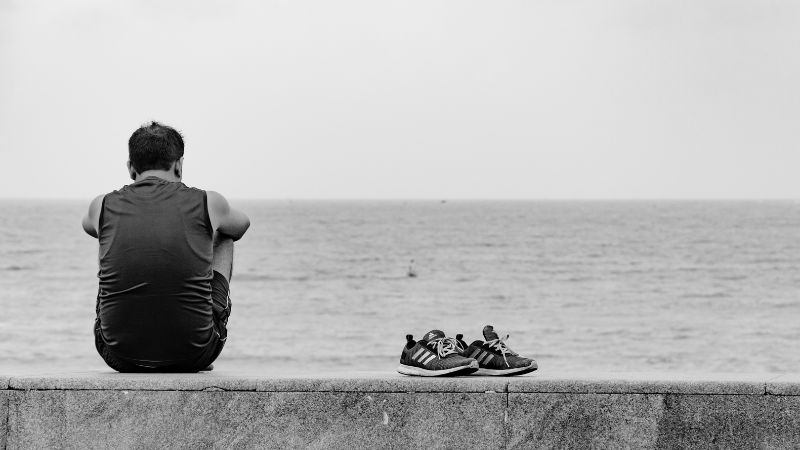
I started turning down plans to meet friends. The incredible thing about this city is that if you say no often enough, it takes you quite literally and leaves you alone. For some time, my only link to the outside world was when the lights would come on in the apartments in the building next to mine at dusk. I would watch life playing out in other rooms while mine had come to a standstill.
One day, a few months after the relationship ended, she messaged out of the blue, wanting to return the books she had borrowed. She said she was sorry for the way she had ended things. ‘It was the only way I could do it,’ she wrote. ‘I am messaging you because I have decided to choose love and would like to provide you closure … I want you to wish me luck.’
I remember the day clearly because, a few hours before, my landlord, a retired chartered accountant, rang my bell to inform me that the building was likely headed for redevelopment. He said I may have to move out soon. The cook had brought some kharvas from her village to celebrate her son clearing the class ten exams. And then, as if someone had pulled back the curtains, light poured in—and just like that, the sadness lifted. I was just broken. I remember having the urge to go on a walk to Dadar Chowpatty to watch the lights come on along the Sea Link.
Was this the city’s way of asking me to leave?
*****
This excerpt from The Only City, edited by Anindita Ghose, has been published with permission from HarperCollins India.
 souk picks