

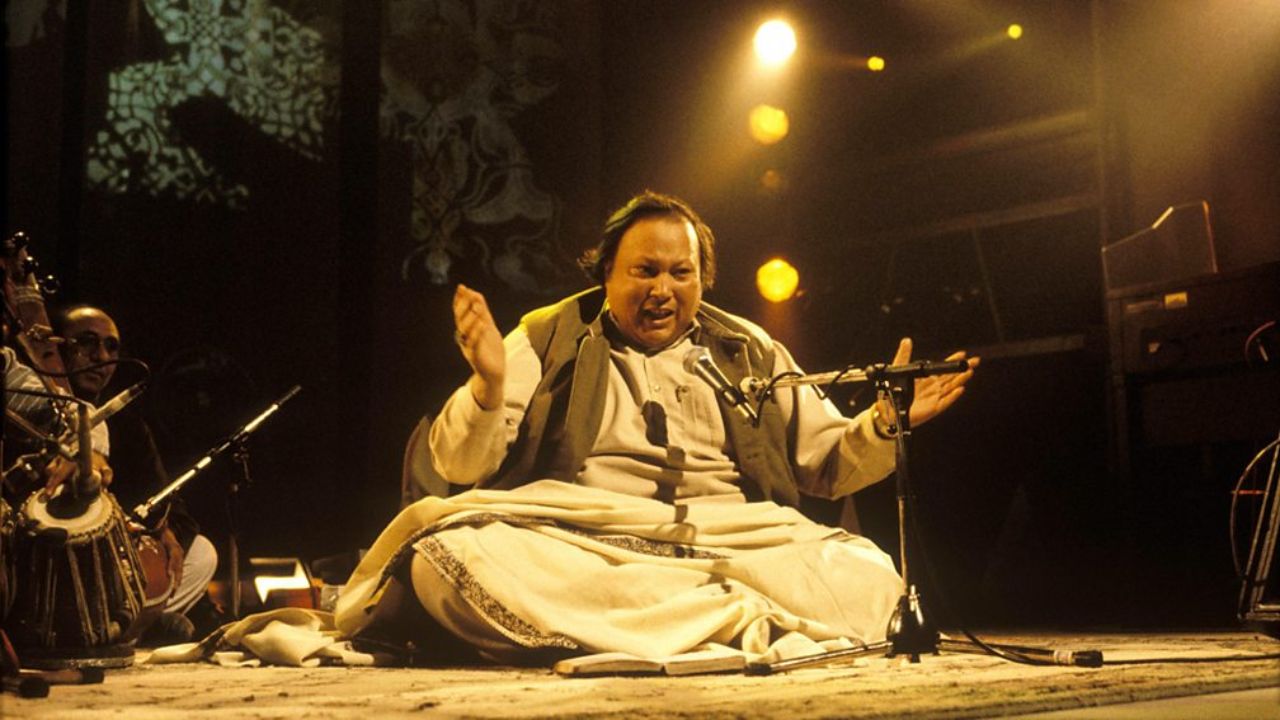
Sufi nights with Nusrat & friends
Editor’s note: In our lead essay this week, Narendra Kusnur takes us on a journey through the mystic lanes of Sufism, unpacking the subcontinental romance with the devotional form. Via stopovers at Coke Studio, Nusrat Fateh Ali Khan, Dhurandhar, Abida Paveen, AR Rahman, and more, he draws a map of qawwali—a style of Sufi music—and its ubiquity in popular music in India and beyond. And, as always, we have a special playlist with all these classics waiting for you.
Written by: Narendra Kusnur
*****
It’s time for something vibrant. Let’s begin with two songs. The first is from a recently successful soundtrack, and the other is the original song that inspired it. We’re referring to ‘Ishq Jalakaar – Karvaan’, reimagined by Shashwat Sachdev in the recent hit film Dhurandhar, and the evergreen rendition of ‘Na Toh Karvaan Ki Talaash Hai’, composed by Roshan and sung by Manna De, Asha Bhosle, Sudha Malhotra, Mohammed Rafi, and SD Batish in the 1960 film Barsaat Ki Raat.
The second song has been a trend-setter among film qawwalis, along with ‘Yeh Ishq Ishq Hai’ from the same film, which also found a recreated version in Dhurandhar. Back in 1960, Naushad used the qawwali style on the classic Mughal-e-Azam song ‘Teri Mehfil Mein Kismat’, sung by Lata Mangeshkar and Shamshad Begum. Here’s a clip.
Though it found a new and larger audience through cinema, qawwali is actually a much larger and older genre. Its origin is attributed to 13th century mystic Amir Khusro, who fused Persian, Arabic, Turkish, and Hindustani traditions to create this kind of music. Delhi-based Khusro composed many popular qawwalis, mostly written as a dedication to his mentor Nizamuddin Auliya. These include ‘Chaap Tilak’, sung in the version below by the Nizami Brothers of Delhi, and ‘Aaj Rang Hai’, presented by the Sabri Brothers of Pakistan.
Before we proceed, a few clarifications are in order. So far, reference has been made to qawwali. Some may wonder how it is different from Sufi music, a term used often by musicians and industry-folk. Sufi is the term given to the broader genre of Islamic music that focuses on divine love and spiritual purity. Qawwali is a type of Sufi music, which has a typical structure and whose aim is to achieve spiritual ecstasy. Sufi music has different forms of presentation and writing, including the naat, kaafi, qawwali, and ghazal. These are broadly categorised under Sufiana kalaam, and popular Sufi poets were Baba Bulleh Shah, Hazrat Shah Hussain, and Khwaja Ghulam Farid. Here’s a Sufi ghazal ‘Jabse Tune Mujhe Deewana Banaya’ sung by Pakistani doyenne Abida Parveen and written by Hakeem Nasir.
Qawwali has a typical structure. Traditionally, it was sung in a Muslim saint’s shrine, or in a community building called khanqah. It is performed by soloists or duos with the accompaniment of chorus and instrumentalists. Pakistani legend Nusrat Fateh Ali Khan, for instance, had a troupe comprising family members like his brother, nephew, brother-in-law, and cousins. A typical qawwali group is all-male, and besides the main singers, consists of chorus singers, harmonium, tabla, and percussive hand-clapping. Modern ensembles also use bansuri or sarangi. Most qawwalis are lengthy, even going up to 25 or 30 minutes, and here, we have picked the relatively shorter ones. That still means 10 or 12 minutes—so be prepared. To understand how a qawwali troupe performs, watch Nusrat’s rendition of the traditional ‘Nit Khair Mangana’ at a 1988 concert in Birmingham.
Qawwalis can be classified as traditional, film, and popular non-film. In the traditional category, though the Sabri Brothers had a huge following, it was Nusrat who helped the genre reach a wider international audience. The great British musician and promoter Peter Gabriel signed him on to his Real World record label and gave him a platform at the World of Music, Arts & Dance (Womad) festival. Besides traditional songs, Nusrat also recorded the ambient, non-qawwali album Night Song (1996) with Canadian producer Michael Brook. He also made a foray into Bollywood, but sadly died at the age of 48 on August 16, 1997. His nephew Rahat Fateh Ali Khan does both traditional qawwali and commercial Sufi-based fare. Here, let’s play ‘Sweet Pain’, where Nusrat and Brook do a modern take of the Sufi kaafi ‘Ni Saiyon’ written by Shah Hussain.
From the same generation as Nusrat, India produced many great qawwali and Sufi artistes like the Wadali Brothers, Nizami Brothers, and Warsi Brothers, with Munnawar Masoom and Dhruv Sangari representing the next generation. From Pakistan, the late Pathanay Khan was revered for his Sufi music, and the Fareed Ayaz-Abu Mohammed duo is now popular. The Wadali Brothers Puranchand and Pyarelal, hailing from the Amritsar district in Punjab, have had a huge draw among Indian audiences. After Pyarelal Wadali passed away in 2018, Puranchand’s son Lakhwinder carried forward the legacy. Let’s listen to a studio recording of the Wadali Brothers song ‘Ghoonghat Chak Ve Sajna’, written by Baba Bulleh Shah, followed by a live rendition of Lakhwinder Wadali presenting ‘Tu Maane Ya Na Maane’ popularised by the senior duo.
Pure qawwali is normally associated with male singers, but many women have also sung the poetry of Sufi mystic saints. Abida Parveen was a pioneer, and today, many women are presenting the verse of the master poets. In India, singers like the Nooran Sisters, Radhika Sood Nayak, Kavita Seth, Pooja Gaitonde, Sonam Kalra, and Smita Bellur have practised the art. Here, let’s see Jyoti Nooran render Bulleh Shah’s ‘Akhiyaan Udeek Diyaan’.
Though most Sufi kalaam and qawwali refers to Islamic thought, there have been instances where Hindu bhakti songs have been presented in a Sufiana style. The most popular example is Nusrat’s 30-minute rendition of the bhajan ‘Saanson Ki Mala’. Here, let’s see a shorter and more modern take by Pakistani singer Hadiqa Kiani.
After Nusrat’s passing, there have been many efforts to carry forward his music. His nephew Rahat has presented many of his songs at live shows, and platforms like Coke Studio have featured modern adaptations of his numbers. Here, let’s watch the Uttarakhand group Rehmat-e-Nusrat, led by Sarvjeet Tamta, present the popular ‘Man Kunto Maula’ at a show in Amritsar last year. This is followed by a unique take of ‘Ni Saiyon’ by Lahore-based Mekaal Hasan Band, which has released jazz-inflected versions of Nusrat classics.
That brings us to film qawwalis. Most of them have nothing to do with the soul or spirituality, and are as such pooh-poohed by the purists. Since they require specific situations, there aren’t too many filmi qawwalis. But a few have continued to entice audiences over the years, and they use the composition style of traditional qawwalis. Examples are ‘Jhoom Barabar Jhoom Sharabi’ (in the film Five Rifles, 1974), ‘Parda Hai Parda’ (Amar Akbar Anthony, 1977), ‘Hai Agar Dushman’ (Hum Kisise Kum Naheen, 1977), the Qurbani title song (1980), ‘Piya Haji Ali’ (Fiza, 2000) and ‘Bhar Do Jholi Meri’ (Bajrangi Bhaijaan, 2015). Let’s watch ‘Parda Hai Parda’, composed by Laxmikant-Pyarelal and sung by Mohammed Rafi, and ‘Bhar Do Jholi Meri’, which is actually a recreation of a Sabri Brothers song, sung in the film by Adnan Sami to Pritam’s arrangement.
Besides the qawwalis, many songs use Sufi musical styles and pass off as Sufi music, just by adding words like ‘maula’ (master) and ‘murshid’ (teacher). Of course, music director AR Rahman has produced some authentic Sufi songs like ‘Khwaja Mere Khwaja’ (Jodhaa Akbar, 2008) and ‘Kun Faaya Kun’ (Rockstar, 2011). Let’s watch the former.
The number of non-film qawwalis is even lower, and of the hits, Aziz Naza’s ‘Chadhta Suraj’ comes to mind. Besides this video, let’s watch this rendition of Hadiqa Kiani’s ‘Boohe Bariyan’, which though originally written as a Punjabi folk-pop song, is presented in qawwali style in this show.
Finally, one must talk of the fusion of Sufi styles and rock, first heard in Pakistani bands like Junoon, Fuzon, and Mekaal Hasan Band. The Sufi Gospel Project, formed by Delhi singer Sonam Kalra, lives up to its name, and so does Sufi Jazz, by keyboardist Louiz Banks and singer Pooja Gaitonde. There are also songs like ‘Menda Ishq’, written by Khwaja Ghulam Farid, which have been adapted by Delhi band Advaita. Let’s hear Sonam and the Sufi Gospel Project on ‘Chal Bulleya’.
An apt conclusion would be a song performed at almost every Sufi concert. We’re talking of ‘Damadam Mast Qalandar’, written in reverence to Sindhi Sufi saint Shahbaz Qalandar. Though the hardcore Sufi fans feel this song and ‘Chaap Tilak’ are overplayed, they always ensure that the crowd sings and dances along. Here’s Abida Parveen’s version from the 2015 Dhaka International FolkFest.
That’s qawwali, summed up, with a sprinkling of other Sufi styles. To recap, here’s a list of songs mentioned.
- Shashwat Sachdev – Ishq Jalaakar Karvaan, Dhurandhar
- Roshan – Na Toh Karvaan Ki Talash Hai, Barsaat Ki Raat
- Naushad – Teri Mehfil Mein, Mughal-e-Azam
- Nizami Brothers – Chaap Tilak
- Sabri Brothers – Aaj Rang Hai
- Abida Parveen – Jabse Tune Mujhe Deewana
- Nusrat Fateh Ali Khan – Nit Khair Mangana
- Nusrat Fateh Ali Khan – Sweet Pain
- Wadali Brothers – Ghunghat Chak Ve Sajna
- Lakhwinder Wadali – Tu Maane Ya Na Maane
- Jyoti Nooran – Akhiyaan Udeek Diyaan
- Hadiqa Kiani – Saanson Ki Mala
- Rehmat-e-Nusrat – Man Kunto Maula
- Mekaal Hasan Band – Ni Saiyon
- Laxmikant-Pyarelal – Parda Hai Parda, Amar Akbar Anthony
- Pritam – Bhar Do Meri Jholi, Bajrangi Bhaijaan
- A.R. Rahman – Khwaja Mere Khwaja, Jodhaa Akbar
- Aziz Naza – Chadhta Sooraj
- Hadiqa Kiani – Boohe Baariyan
- Sonam Kalra & the Sufi Gospel Project – Chal Bulleya
- Abida Parveen – Damadam Mast Qalandar
*****
Narendra Kusnur has been a music journalist for over 40 years—including a decade-long stint covering the beat at the Mid-Day newspaper. He currently writes for The Hindu, Free Press Journal, Hindustan Times, and Rolling Stone India—besides the in-house magazines of prestigious institutions—such as NCPA and Shanmukhananda Hall.
 souk picks