

The ja-and-sha breakfast experience
Editor’s note: Through 10 delightful vignettes, author Priyadarshini Chatterjee takes us on an electric journey across urban India and the country’s relationship with breakfast. First Bite, her new book, is an examination of the everyday habits and cultural intersections that make Indian breakfast so alive and diverse. From Amritsar’s magic water making the city’s kulchas the greatest in the world, to Bengaluru’s continental offerings from a bygone era, to a culturally eclectic spread in the sacred city of Varanasi, Chatterjee travels through 10 cities and brings to light undiscovered tales of historical migration, assimilation, habit, and necessity.
Here, she takes us through a quintessential Khasi breakfast, featuring the city’s famous ja-and-sha (rice and tea) stalls and kong shops—class agnostic spaces where people gather for an early morning meal—run by women. This excerpt from First Bite: Breakfast Stories from Urban India by Priyadarshini Chatterjee has been excerpted with permission from Speaking Tiger Books.
*****
Garo food is not easy to find at commercial eateries in Shillong, but the quintessential Khasi breakfast, or morning meal, of tea and rice is served out of the numerous ja-and-sha stalls strewn across Shillong and around the Khasi hills—on highways, busy intersections, and in marketplaces. These eateries are small, no frills establishments that sell no-nonsense, home-cooked Khasi meals of rice—typically local, unpolished red rice—served with robust sides of pork and beef, or chicken, some fish, and a smattering of vegetables, along with tea, from early morning. A bed of rice is laid out on small steel plates, the size of a quarter plate, and sides and condiments are spooned on top, often in a floral arrangement around the rim. It’s a meal that hews to the geography of the region—stridently traditional fare.
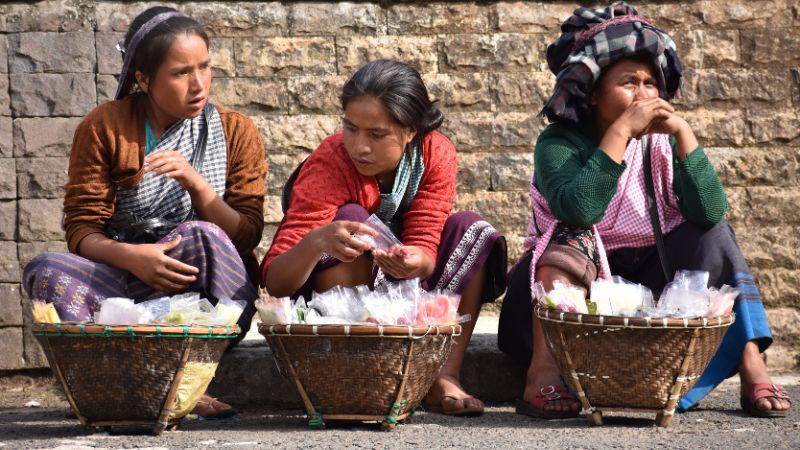
Predominantly run by women, these eateries are also called kong shops. Kong means sister in Khasi. Even if these look like typical working-class establishments, these stalls are often class agnostic spaces where people from all walks of life come for a sumptuous, inexpensive, traditional meal—functional food to fuel the morning’s activities.
Kong shops range from small, permanent shops—often with glass-and-timber storefronts and curtained doors—to makeshift stalls that come up early in the morning at busy intersections and commercial districts across town, serving a selection of traditional Khasi dishes. Friends in Shillong tell me of specific areas where such breakfast stalls come up every morning—outside the Civil Lines Hospital, for instance, where vendors serve up everything from rice and jadoh, meat and fish curries, boiled egg chops, to kala chana laced with black sesame paste, sold in tiny transparent plastic pouches tied with strings, from five in the morning. The food can be cold—prepared in homes long before it’s served. Hawkers used to put up crack-of-dawn breakfast stalls in Shillong’s bustling Police Bazaar area, until the municipal authorities rolled out strict restrictions against street vending. The historic commercial district swapped its original name, Khyndailad, with Police Bazaar, after a police station in the vicinity.
I hear that, initial resistance notwithstanding, many of the street hawkers of the area were evicted from their spots only days before my visit, as part of an eviction drive that proposes to relocate the area’s hawkers to the multilevel parking complex of the Meghalaya Urban Development Authority in order to decongest the Police Bazaar and eventually pedestrianise the area, also one of Shillong’s greatest tourist draws. So I miss the quintessential experience of polishing off hot plates of jadoh on a cold Shillong morning, standing in the heart of Khyndailad.
Instead, early one morning I hail a kali-peeli to Laitumkhrah, a lively neighbourhood known for its markets, quaint churches, and old houses, on the suggestion of the taxi driver who brought me to Shillong. A Marwari born and brought up in Shillong, he knows the city well. At the intersection near Nazareth Hospital, he had told me, vendors—mostly women—put up makeshift stalls as early as 5:30–6:00 in the morning. Locals—morning walkers, young athletes, school students and college-goers, shopkeepers and newspaper hawkers, hospital staff—all flock to these stalls for their morning’s fill of rice.
The city is still quiet, slowly rousing into action, and the roads are still empty before the school-hour traffic hits. When I reach the intersection, I spot groups of people flocking to one stall or another like bees to flowers. I am quick to join a local shop owner, a businessman running an errand in the vicinity, and two schoolboys at a makeshift stall run by Icidora Pailar for a meal of rice, pork curry, chicken liver cooked with an oleaginous paste of black sesame (first toasted to prod its nuttiness out), and stir-fried radish leaves. Icidora’s daughter Jenny insists I add a splotch of tung-tap to my meal. It is a thrilling, tongue tingling condiment made with fermented dried fish and muddled with jaiur, an indigenous variety of Sichuan pepper that gives the condiment its buzzing heat. Icidora doesn’t speak English, but she smiles at me constantly. ‘She cooks all the food,’ Jenny tells me, ‘from three o’clock in the morning.’
Across the intersection, near Nazareth Hospital, another mother-daughter duo, Rishona and Anjulia, work out of the Maruti Omni they have converted into a breakfast truck of sorts. Rishona sits surrounded by a constellation of vessels, ladling food onto steel plates with robotic efficiency, while her daughter shouts out orders and keeps accounts. There’s beef liver and pork innards, chunks of dried beef cooked in a soupy curry, beef syrwa (stew), meatballs, and more. Most of her customers are women—school and college students, middle-aged women on their way to work. While public breakfast spaces have more often been predominantly male spaces in other parts of India, there’s a remarkable presence of women—both buyers and sellers—here in Meghalaya.
*****
This excerpt from First Bite: Breakfast Stories from Urban India by Priyadarshini Chatterjee has been excerpted with permission from Speaking Tiger Books.
 souk picks