

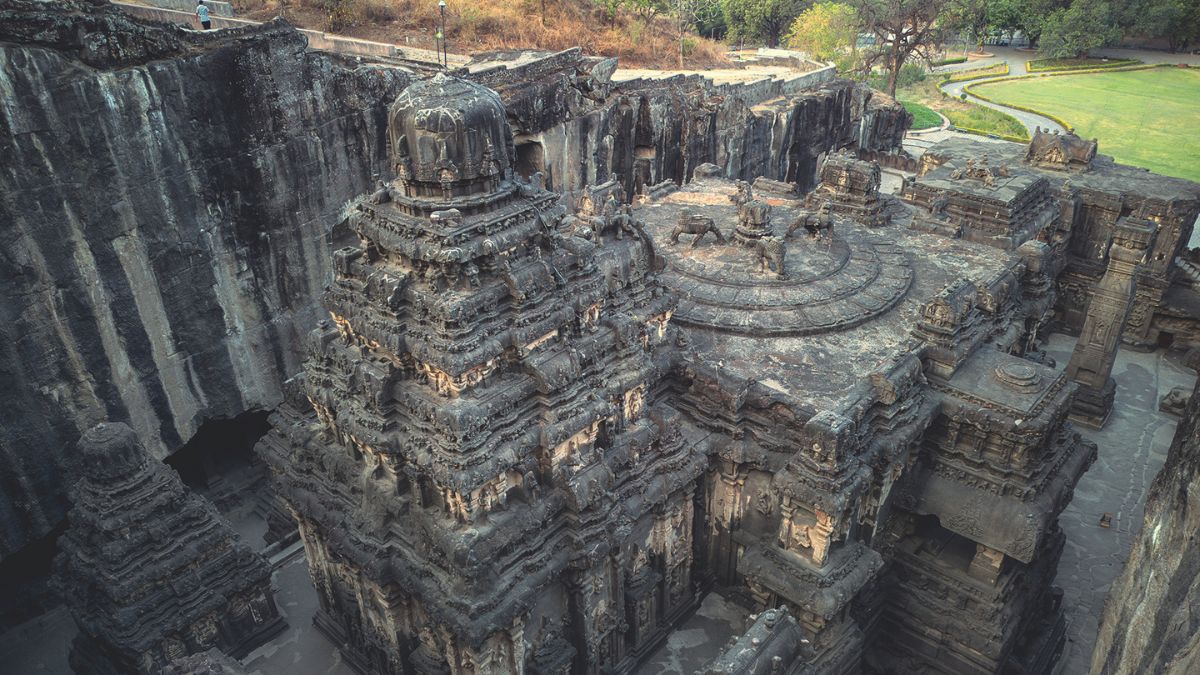
Kailash: Ellora’s extraordinary Cave 16
Editor’s note: The magnificent scale and beauty of Kailash, or Cave 16, among Ellora’s stunning works of sculpture and art, emerges as you approach it from on top of the hill. This cave temple is an exceptional feat of architecture, standing tall till today. Here, Deepanjana Klein takes us through the majesty and religious imagery of this iconic temple.
The following excerpt from Ellora: Cross-fertilization of Style in Buddhist, Hindu and Jain Cave Temples, by Deepanjana Klein and Arno Klein, has been published with permission from Mapin Publishing. The book is available to order at Mapin Publishing's website and other leading bookstores.
*****
The magnificent scale of Cave 16 (Kailash), the brilliant feat of architecture and engineering, and the exceptional sculptural panels are all-consuming as one walks through one of the most extraordinary creations of humankind. Approaching Kailash from the top of the hill allows the viewer a greater appreciation of the scale and also an understanding of how the monolithic cave temple may have been conceived. Carving from the top and working their way down, with no room for error, makes abundantly clear the level of precision and planning this project required. Kailash cannot be described as a cave and neither is it a structural temple; it is perhaps the largest and most intricate sculpture to have ever been carved in the world.
The main central temple was built during the reign of King Krishna I (r. 756–774 ce) of the Rashtrakuta dynasty and is dedicated to Lord Shiva, represented in his numerous manifestations, from benevolent to ferocious. While there is no direct inscription on Cave 16 specifically attributing its construction or embellishment to the Rashtrakuta kings, they are known to have commissioned various architectural projects throughout their empire. Inscriptions from other sites, such as those in the Saka era and later records, mention the Rashtrakutas’ patronage of major temples and support for religious institutions, suggesting their involvement in projects like Kailash. The Aihole inscription of Pulakeshin II provides some context by celebrating the military conquests, achievements, and general support for temple construction by the Rashtrakuta kings. While this specific inscription does not directly mention the Kailash temple, it highlights that this attribution is supported by a combination of historical inscriptions, records, stylistic analysis, and the broader pattern of Rashtrakuta patronage of temple architecture.
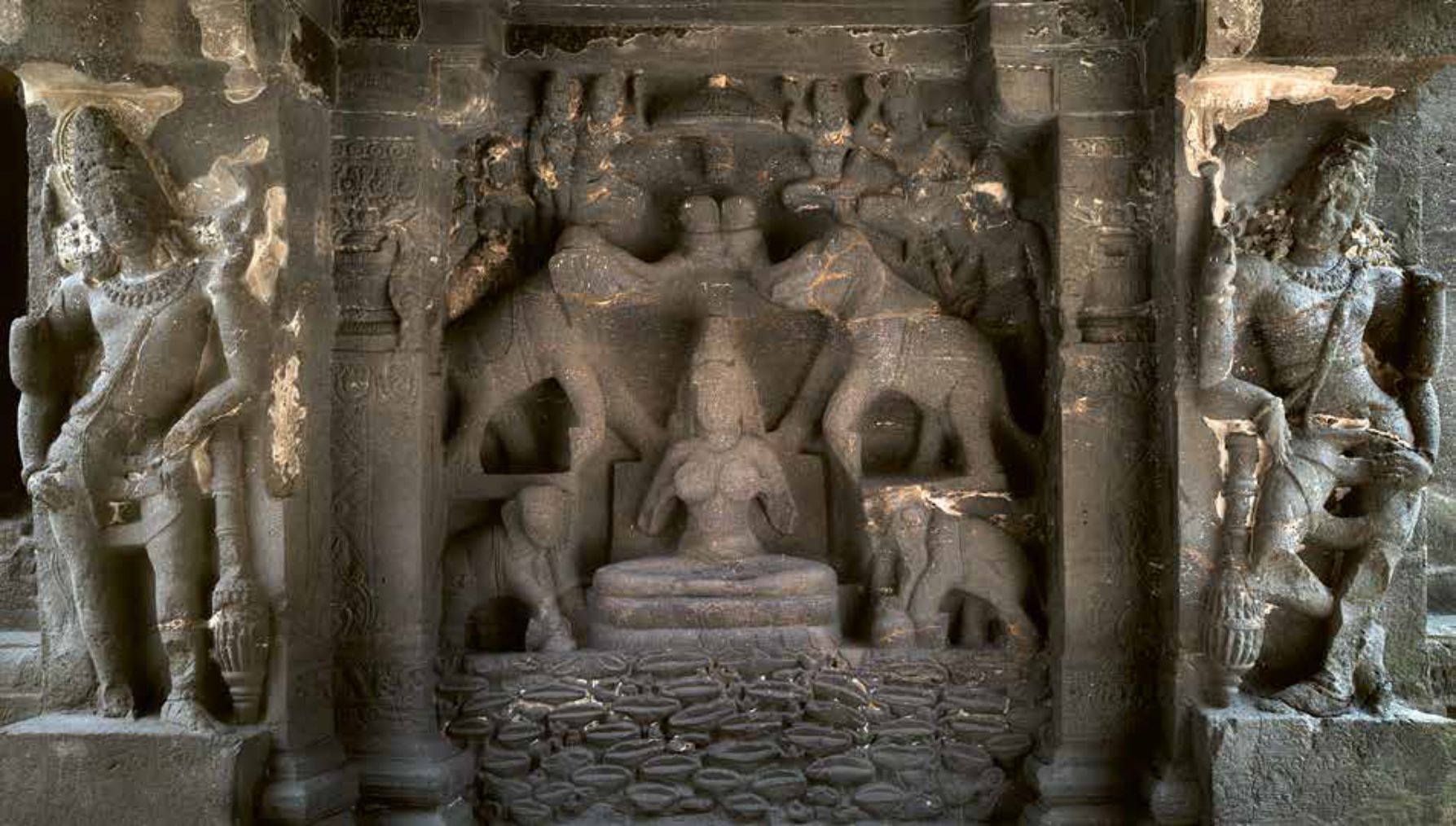
Entering through the main facade, one is greeted by a colossal sculpture of Gajalakshmi, seated on a bed of lotus blooms floating in water, populated with little birds and other aquatic creatures in lively splendor. Two elephants flank Gajalakshmi and two more lustrate her from the pots of water they hold over her head. The grand scale and the opulent presence of Gajalakshmi right at the entrance creates the ambience of abundance and good fortune of the Rashtrakuta dynasty. It prepares the audience for the overwhelming experience of the grand corridor surrounding the main temple.
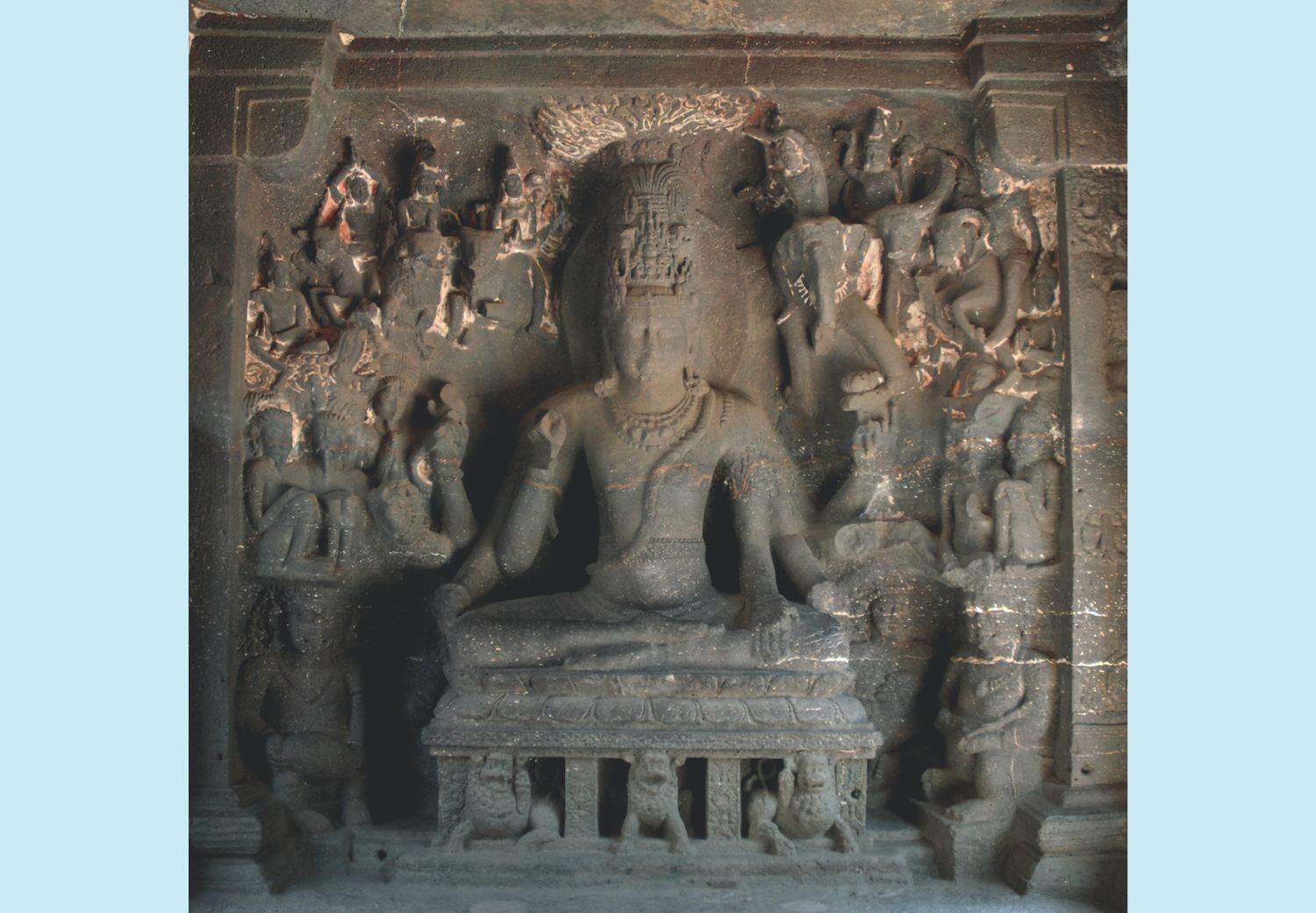
Immediately behind the Gajalakshmi are two forms of Shiva of monumental scale. One is Shiva in his fierce form, killing Andhakasura. Shiva diagonally cuts across the composition with his ten arms fanning out, holding appropriate accoutrements, creating a centripetal force that adds extreme drama to the overall composition. Saptamatrika are seated at the bottom of the panel, while Bhringi dances for joy under Shiva’s legs. The juxtaposition of Shiva’s foot crushing Apasmarapurusha (the demon of ignorance), as he extends one of his hands to tenderly touch Parvati to reassure her captures the fierce and the benevolent in Shiva in a single composition. It is one of the most dramatic and forceful compositions in the temple complex. Directly opposite is the most benign form of Shiva as the meditative Mahayogi, seated on a lotus throne supported by three lions. He is surrounded by gods on all sides: Varuna and Vayu on their crocodile and deer vahanas, Mahesha on his bull, Indra on his elephant, Yama on his buffalo, Agni on his ram, Kubera on nara vahana (a dead body as his vehicle), and dikpalas (guardian deities) all celebrating the Mahayogi.
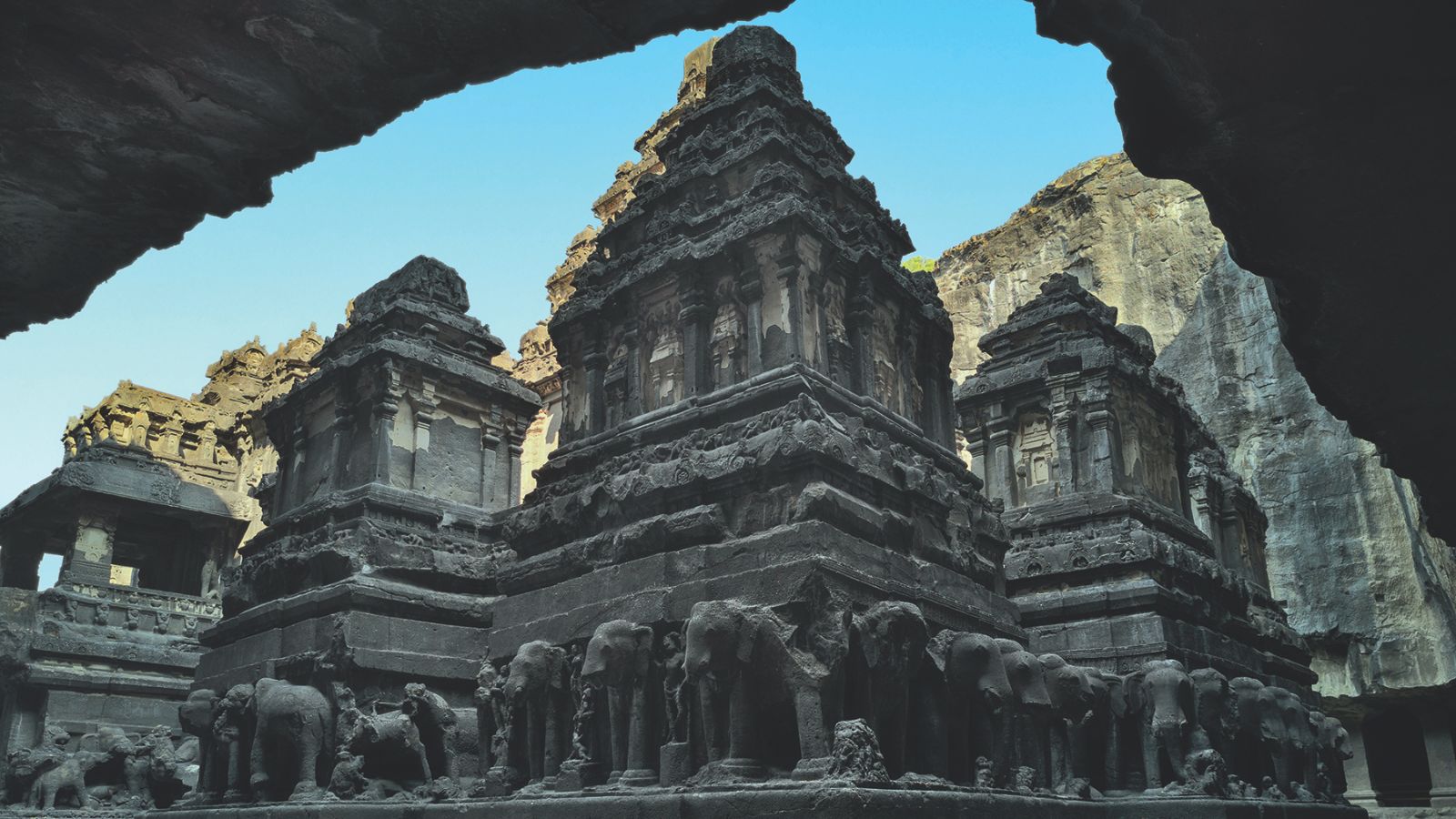
The juxtaposition of the three sculptures right at the entrance—the Gajalakshmi, Andhakasuravadh, and Mahayogi—speaks of the abundance of wealth, power, and vision of King Krishna I and the Rashtrakuta empire. Given the attention to detail it took to architect Kailash, it is not surprising that the major sculptures are placed in the most strategic locations in the temple complex. It is in this temple that one experiences the confluence of power, prestige, and expression of the greatest Hindu myths. The main temple at the center of the complex sits atop a high plinth, which is supported by a ring of beautifully carved, life-size elephants and vyalas (mythical lions) that run the entire length around the temple. These creatures in various positions create movement, as if the whole temple were poised to go on a procession at any moment. Handsome, playful, and lively, they present a spectacle that invites the viewer to circumambulate the main temple before ascending the stairs to the main shrine.
*****
This excerpt from Ellora: Cross-fertilization of Style in Buddhist, Hindu and Jain Cave Temples, by Deepanjana Klein and Arno Klein, has been published with permission from Mapin Publishing. The book is available to order at Mapin Publishing's website and other leading bookstores.
 souk picks