

Written by: Aarthi Ramnath, Raghav Bikhchandani & Yash Budhwar
Our daily list of Souk picks
Editor’s note: As you may have noticed, we just unveiled a beta version of Souk—which has one simple goal: To help you find unique, high quality products that are worth your time and money. We’re picking our faves from their latest curation in the House & Living section—this one’s all about essentials to dress up your dining table!
One: One thing that adds the colour back into a laid dining table is a plant. These amaranth stems have an almost sculptural quality to them—long, trailing, and a little dramatic in the best way. The green or burgundy hues could pair well with other blooms, but also look striking solo in a tall vase.
Two: Or you can get this large green glass vase from H&M. The uneven shape gives it presence without overpowering the table, and it has that handblown look—minus the price tag. Works beautifully with sculptural stems, a single palm leaf, or left empty as a subtle accent. A quiet, elegant piece that makes everything else on the table look better.
Three: We love a piece that multitasks and these Footed Small Glass Compotes do just that. Use them for scoops of gelato, fruit, or puddings, or bring them out with a bottle of bubbly when you’re short on coupes. The hammered texture gives them a soft shimmer, the recycled glass adds character (and conscience). Plus they're hand-blown which makes each piece unique.

You can check out the rest of the list here. There is much, much more over at souk.splainer.in for you to discover, be it Thai cooking essentials or pet-friendly carpets!
PS: This is a beta launch and feedback—good or bad—is key. So please email the team at dearsouk@splainer.in with your thoughts. We want to get this right!
The hidden horrors of Vantara
The context: The “world’s biggest wild animal rescue centre”—more likely, Anant Ambani’s private zoo—is home to more than 150,000 animals; home to 200 lions, 250 leopards and 900 crocodiles. It has been in the headlines for all the wrong reasons lately—the latest being the controversial transfer of a 36-year-old elephant named Madhuri from a Jain monastery in Kolhapur—where she had been since 1992—to Vantara. There have been other allegations of wildlife trafficking especially of elephants from the Northeast.
What happened now: On Monday, the Supreme Court formed a Special Investigation Team (SIT) in response to two petitions. They accuse Vantara of “unlawful acquisition of animals from India and abroad” and “mistreatment of the animals in captivity, financial irregularities, money laundering, etc.” The SIT is made up of former Supreme Court and High Court justices—and has a fairly broad remit:
The SIT would look into the acquisition of animals from India and abroad, particularly elephants; compliance of Wild Life (Protection) Act, 1972 and Rules for zoos; compliance with the International Convention on Trade of Endangered Species of Flora and Fauna (CITES) and import/export laws concerning live animals; check compliance with standards of animal husbandry, veterinary care, standards of animal welfare, mortalities and causes; examine complaints regarding climatic conditions and allegations about the location of Vantara near an industrial zone.
What’s interesting: The same Court dismissed a plea to return rescued elephants from Vantara on August 14—calling it "completely vague.” It was almost identical to the petitions that led to this ruling. No one has a clue why the Court changed its mind in such short order (which is becoming a bit of a trend these days. See: stray dogs).
Is any of it true? In March, a joint investigation by the investigative media outlets Süddeutsche Zeitung and Armando Info found that an eye-watering number of animals—39,000—had been brought in by the end of 2024. In comparison, one of the world’s largest zoos—in Berlin—has only 2,500. Most zoo experts say it is not possible to properly care for so many animals—most of which were acquired over just nine months:
Theo Pagel, who directs the Cologne Zoo, is also surprised by the import figures. "We had 384 new animals arrive last year, and I know what a logistical task that was," he says. According to data, Vantara received more than 30,000 animals during the same period. "You have to quarantine the animals, study their temperament, and acclimate them to new groups," says Pagel. "And you can't put 100 giant otters into a large enclosure, or 142 anteaters, because they don't get along with each other."
Making things shadier: In India, PETA has been a prominent partner of Vantara—with its global chief endorsing the project. But Vantara is not a part of any global conservation alliance:
Although the project advertises its collaboration with well-known conservation organizations such as WWF and IUCN, which publishes the "Red List" of threatened species, both organizations denied collaborating with Vantara when contacted by the Süddeutsche Zeitung.
Nor has it partnered with other zoos—which is necessary to ensure proper conservation and breeding of endangered species.
The most alarming bit: is the places from which Vantara sources its animals. Anant Ambani claims the centre rescues abused or abandoned wild animals. But the investigation shows otherwise:
These include numerous zoos, but also commercial animal traders. They are based in countries such as Venezuela, the Democratic Republic of Congo (DRC), and Indonesia, which are considered hotspots for the illegal trade in wild animals captured there. They also operate in the United Arab Emirates (UAE), an international hub and destination for this trade.
The big picture: India has strict rules for the import and export of wild animals—rescued or otherwise. None of them seem to apply to the Ambanis. We now have 39,000 animals left at their mercy in a private zoo with zero oversight. The SIT is at least a first step toward enforcing accountability.
Reading list: The Süddeutsche Zeitung investigation is behind a paywall—but The Guardian has some of the findings. The Hindu reports on the special investigative team and its goals. Our Big Story has the origin story and everything you need to know about Vantara.
Emmanuel Macron: International hero, domestic zero
The context: The French president has been making global headlines for taking the lead on Gaza—and standing up to Washington. But his own government is tottering on the edge of collapse. It all went wrong when he called a snap parliamentary poll last year—and came in second. Then Macron made it worse by ignoring the winners—an alliance of Left parties—and picking a rightwing PM, Michel Barnier. But within three months, Barnier lost a no-confidence vote—and was replaced by Macron’s fave—the centrist François Bayrou—equally unpopular with the Left.
What happened now: Macron’s dictatorial posturing may soon come to naught. His government is slated to collapse once again—because it has not solved France’s biggest and most pressing problem: It’s drowning in debt. France’s deficit was €168.6 billion or 5.8% of the GDP in 2024. That’s worse than Greece, Spain and Italy. The GDP growth forecast for this year is just 0.8%.
The big, booming alarm bell: The French Finance Minister triggered panic when he suggested that Paris may need to be bailed out by the IMF:
Fanning the concerns was a warning early on Tuesday by the French finance minister, Eric Lombard, that France may need assistance from the International Monetary Fund if the crisis cannot be brought under control. “I cannot assure you that the risk of I.M.F. intervention does not exist,” he said in an interview on French radio…
[W]ithout urgent action, the interest rate that France would have to pay investors to buy its sovereign debt would surge within two weeks past that of Italy, another big European country with troubled finances. If that happens, “we will really have fallen to the bottom of the pile in the European Union,” he said.
The culprit: for this hot French mess is Macron—whose “unbridled government spending” has created exponentially rising debt:
The debt exploded in the first quarter of this year to €3.3 trillion, or more than 114 percent of the country’s gross domestic product. Mr. Bayrou has warned that if nothing is done, debt interest will become the government’s largest expense by 2029, ballooning to €100 billion per year.
But, but, but: Since Macron has spent most of his remaining time pissing off the Left, they have opposed all attempts to slash spending. And since this is France, the bit that has caused “nationwide fury” is the plan to cut two national holidays: “Easter Monday and May 8, which commemorates the end of the Second World War in Europe and is often used as a ‘bridge’ by the French to take a four-day weekend in the middle of spring.”
What’s next: Almost everyone agrees that Bayrou will lose his no-confidence motion—set for September 8. The political crisis will trigger even greater financial instability. If Macron is forced to call a snap election, it will be a boon for the far-right—which did unexpectedly poorly in 2024—but has plenty of voter fury to propel its fortunes this year. All this because he wasn’t willing to cede an inch to the Left.
Why do you care: A rightwing French government will have far-reaching repercussions for the EU, Gaza, Ukraine and more.
Reading list: The Guardian has the best overview of the issue. New York Times has reports on France’s economic crisis and Bayrou’s proposed budget. For more on the last parliamentary election, we did a Big Story in July 2024.
Mega-rocket Starship finally takes flight
The context: Elon Musk’s Starship rocket—the largest and most powerful ever—is intended to take people to the Moon and eventually Mars. But its previous test flights have ended badly—exploding either at the dock or midair. Many wondered if the SpaceX spacecraft was a dud.
What happened now: On Tuesday night, the 400-foot-tall rocket finally soared into space:
The signs were positive from the start of Tuesday's test flight. All of the booster's 33 engines fired up, and after about seven minutes, the booster separated from the spacecraft and fell into the Gulf of Mexico. Starship continued to ascend, reaching a maximum height of almost 200km above Earth, before coasting around the planet.
You can watch the liftoff video below.
Or this cool POV from the rocket’s launch mount, right beneath the thrusters:
As for the rest: The rocket’s upper half then released dummy satellites, re-entered the atmosphere, and splashed down in the Indian Ocean, which you can see below.
It wasn’t perfect—parts of the rocket caught fire and blew apart, and the booster engine eventually exploded in the Gulf of Mexico—but it was an unqualified success as a test flight. The result comes as a huge relief for Musk—who has been widely criticised for his rash and impulsive leadership. It’s even more important for NASA—which picked SpaceX as a partner for its future mission to the moon—now slated for 2028. But here’s the less-acknowledged bit of bad news:
As NASA’s moon efforts slip into the future, China is making steady progress with its program to land its astronauts there before 2030. It announced this month that it had successfully tested a lunar lander. Even after Tuesday’s successful test flight, Mr. Harrison said he thought there was a greater than 50/50 chance that China would reach the moon before NASA did with Artemis III.
Lots more on the launch over at New York Times, login required, and BBC News.
MAP Academy & Nalli Fellowship is now open!!
Editor’s note: As you know, the wonderful MAP Academy is our content partner for Advisory. It is one of the few Indian institutions deeply invested in cultural research and education. They also offer rare funded opportunities for researchers, designers, archivists, journalists, writers and educators. The Nalli Fellowship is one of them.
Over to MAP Academy…
Are you working on the histories and practices of South Asian textiles and their socioeconomic, environmental or cultural implications?
The MAP Academy & Nalli Fellowships is offering four Research Fellowships of Rs 5.5 lakh each, for the study of textiles from India, Pakistan, Bangladesh, Bhutan, Tibet, Afghanistan, Myanmar, the Maldives, Nepal, and Sri Lanka. Applications are welcome from individuals—students, journalists, educators, designers, researchers—as well as from collectives and non-profit organisations. The grant must be used to support one year of research, which may be part of a longer-term project.
Applications will be assessed by an Advisory Committee, based on the responses in the submitted form, which will also double as the project proposal. Shortlisted applicants will be interviewed via an online video call, after which a final selection will be made.
Applications will remain open until October 15, 2025.
Find out more, and apply through this link. For any queries, contact us at: fellowships@map-india.org.

what caught our eye
business & tech
- Microsoft’s Redmond HQ went into lockdown after protesters from the “No Azure for Apartheid” group stormed president Brad Smith’s office and livestreamed their sit-in.
- Wall Street Journal (splainer gift link) has a good read on how employee protests over the Palestinian cause have escalated inside Microsoft and Google.
- OpenAI’s corporate restructuring is set to slip into next year as the ChatGPT maker haggles with Microsoft over a long-term contract, stalling its plans to raise billions in new funding.
- Apple will hold its next major event on September 9 to unveil the iPhone 17, iOS 26’s Liquid Glass revamp, and new AI upgrades for Siri.
- Nvidia has blown past expectations with $46.7 billion in quarterly revenue—showing AI demand is still red-hot even as US curbs shut China out of the picture.
- OpenAI says it is updating ChatGPT to better respond to users in mental health crises as it faces a lawsuit claiming the chatbot played a role in a teenager’s suicide.
- Flipkart is facing a preliminary tax probe over allegations it recast marketplace fees as transport charges to cut its GST bill.
sports & entertainment
- Ravichandran Ashwin has retired from the IPL after 16 seasons, months after stepping away from international cricket where he finished as India’s second-highest Test wicket-taker.
- Pulwama, once a militancy hotbed, is hosting its first under-lights cricket tournament—locals say it’s a rare chance to heal old wounds and enjoy late-night entertainment.
- Donald Trump has turned his ire on late-night host Seth Meyers, calling him “talentless” and “the personality of an insecure child” while blasting NBC for renewing his contract.
- Sting has been sued by his former Police bandmates Andy Summers and Stewart Copeland, who told a London court they were denied credit and royalties for the 1983 hit 'Every Breath You Take'.
- Papua New Guinea has made its first-ever Oscars entry with ‘Papa Buka’, an Indian-directed film about a war veteran helping historians uncover WWII stories that link the two nations.
- SS Rajamouli has unveiled the teaser for 'Baahubali: The Epic', a remastered single-film cut of the blockbuster saga re-released for its tenth anniversary with new picture, sound, and surprises.
health & environment
- New research warns that ocean acidification caused by rising carbon emissions is damaging shark teeth.
- The Environment Ministry has set up a 21-member National Designated Authority to launch carbon markets under Article 6 of the Paris Agreement.
- Quartz has a good read on how China’s record-breaking push into solar and wind is turning it into the world’s first “electrostate,” shifting its economy from oil to electricity and reshaping global energy dynamics.
- Eli Lilly’s experimental obesity pill orforglipron has cleared two Phase III trials with strong results on weight loss and blood sugar control, and the company will seek FDA approval next year.
meanwhile, in the world
- Denmark has summoned the top US diplomat in Copenhagen over reports that Americans have been running influence operations in Greenland.
- US Commerce Secretary Howard Lutnick says Washington plans a major shake-up of the immigration system, targeting the H-1B visa programme and green cards.
- Norway’s $2 trillion wealth fund has dropped Caterpillar and five Israeli banks from its portfolio, citing ethics concerns over the use of bulldozers to raze Palestinian property in Gaza and the West Bank.
meanwhile, in India
- The Wire has a good read on how NCERT’s new ‘Partition Horrors’ modules sidestep Britain’s role in Partition while reigniting debates over the BJP’s push to rewrite history textbooks.
- From September 1, thousands of policyholders with Bajaj Allianz and Care Health Insurance may lose cashless hospitalisation after a suspension by hospital networks.
- Maharashtra will launch South Asia’s fastest Ro-Ro ferry on September 1, cutting travel time between Mumbai and Sindhudurg to just five hours.
Four things to see
One: Jammu received 380 mm of rainfall in the last 24 hours—the highest ever recorded since 1910. The torrential rain resulted in landslides and flash floods that have led to deaths of 41 pilgrims en route to Vaishno Devi. The water level in the Chenab River, Tawi River and Ravi River is way past alarming. Over 6,000 civilians have been evacuated—and the yatra has been suspended. See the damage below. (Indian Express)
Two: Unlike the all-white dress code of Wimbledon, the US Open is known for its fits. On Tuesday, after her first-round victory, Naomi Osaka sauntered on to the court looking like this—with roses in her hair and also her Labubu named Billie Jean Bling for added effect. See the vid below. (CNN)
Three: Meet Ned, a very rare garden snail, recently found in New Zealand. He has a left-spiralling shell which means his “shell is like a mirror image, resulting in a flipped shell and reversed reproductive organs—a configuration that affects roughly 1 in 40,000 snails.” This makes it difficult for him to find a mate. New Zealand has now launched a nation-wide swayamvar for him—so he finds true love/lust before he dies. He’s the one in the front in the pic below. (The Guardian)

Four: The Guinness World Record is celebrating 70 years of celebrating the oddest human achievements. To mark the event, Guinness revealed a list of 70 records that have yet to be attempted. But we instead have listed our fave records to date. First, of course, has to be the world’s tallest dog meeting the world’s shortest dog.

Second, Lalit Patidar—a teenager from India has the Guinness World Record for the hairiest face—thanks to a super rare condition called hypertrichosis aka werewolf syndrome.

Third, we also love Dimitri Panciera—who holds the record for the most ice-cream scoops balanced on a cone: 125.

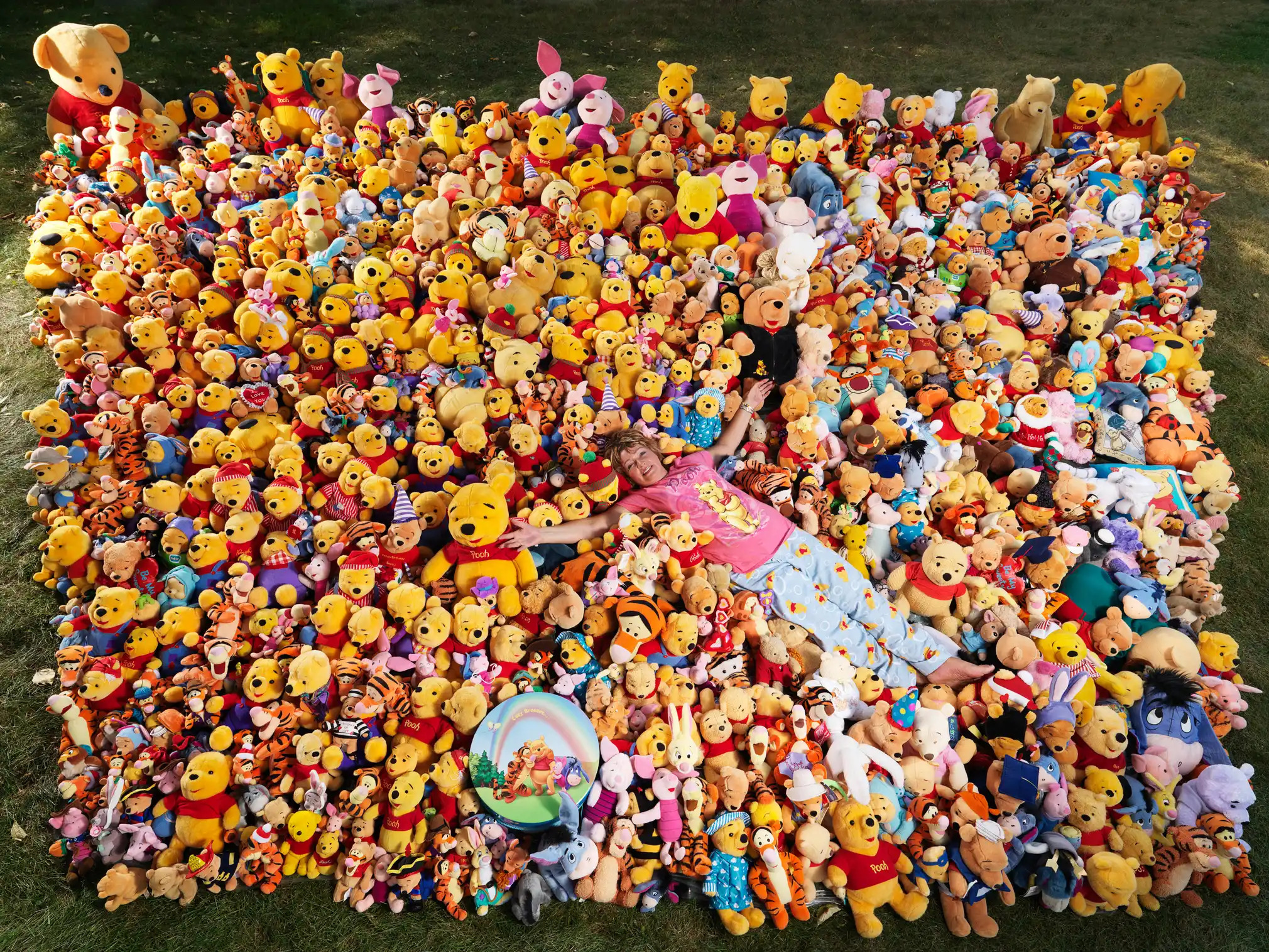
And Deb Hoffmann who owns the largest Winnie-the-Pooh and Friends memorabilia collection—a total of 23,623 items! The Guardian lists more such quirky record holders. (BBC News)
feel good place
One: “Sometimes we need to give ourselves that push.” Lol.
Two: Sneaking a hide and seek game in the middle of guard duty.
Three: When you forget you’re bald now lol: Carlos Alcaraz edition.
 souk picks