

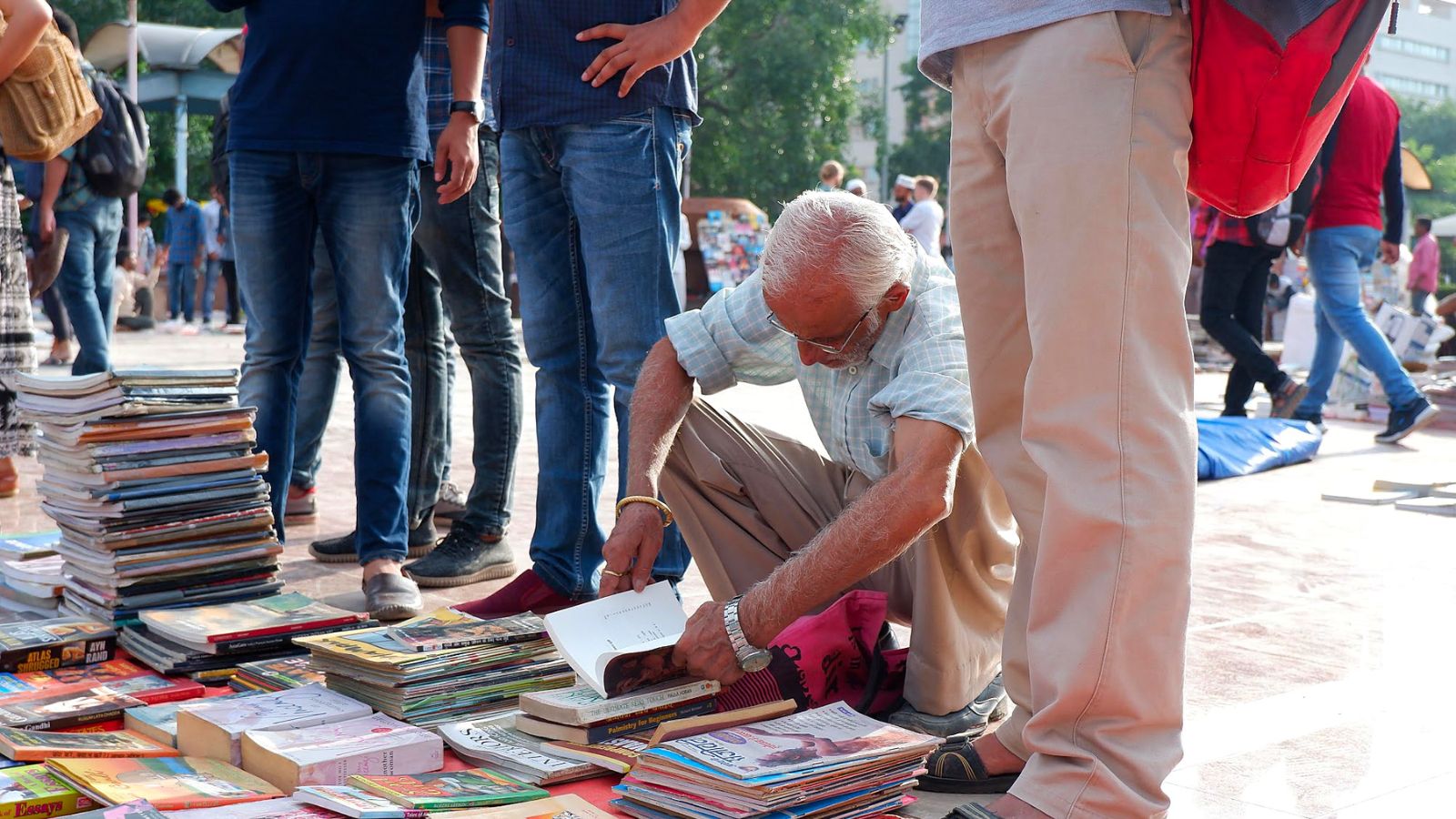
Daryaganj reads: The art of bookselling
Editor’s note: Delhi’s legendary Sunday Book Bazaar, on the ‘patris’ of Daryaganj, is an important part of the city’s cultural inheritance—students, collectors, families, and ‘shauqeen’ buyers have, for decades, found hidden literary treasures in the piles of books here. In the book The Sunday Book Bazaar—part ethnography, part memoir, part urban history—Kanupriya Dhingra brings this vibrant culture to life through the stories of these booksellers and their lives.
Here, we meet Abdul Wali, a vendor at the ‘Patri Kitab Bazaar’, as he explains his innovative bookselling strategies to Dhingra. This excerpt from The Sunday Book Bazaar: Daryaganj and the Making Of a Reading Public in Delhi’ by Kanupriya Dhingra has been published with permission from Speaking Tiger Books.
*****
By the time the first students begin filtering into Mahila Haat, Abdul Wali’s stock is already out and arranged—guidebooks and kunjis sorted by subject, competitive exam materials grouped by examination type, each category occupying its own clear territory. There is nothing haphazard about it. This is a study-material stall, and it looks exactly like one: legible, purposeful, designed for the buyer who already knows what she needs and needs to find it quickly.
When I met him, he spoke to me at length, explaining his business with the thoroughness of someone who has thought it through completely and finds it worth explaining. He showed me his stall contents as he spoke, pointing to specific stacks: why this subject, why this price point, why this edition and not that one. Before I left, he insisted I take a few business cards. It was common among the vendors to assume that a researcher was also someone who might send buyers their way. Most gave me one. I counted—Wali gave me six, and watched to make sure I put them somewhere I would not lose them.
After our conversation, I sat on his side of the stall. I adjusted the tall, colourful sunshade and began taking notes. When a student arrives at his stall, Wali does not wait to be asked. He reads the student quickly and accurately: a first-year student hesitating between editions gets a clear recommendation. If Wali does not have a particular title, he says so immediately and offers to source it. ‘Agle hafte aana. Aap mera phone number le lijiye,’ he tells them. Come back next week. Take my phone number. Hands him a visiting card. The student leaves with what they came for, or with the knowledge that it will be there. Either way, they return.
He looks at me and declares: ‘Ek student ko achha maal do, wo agle saal phir aata hai, apne doston ke saath.’ Give one student good material, and they come back next year, with their friends. This is not simply goodwill. It is a business model, a marketing strategy, refined over decades into something indistinguishable from instinct.
His sourcing is equally precise. He buys from paper markets rather than auctions. Less risk, less storage required, more control over what enters his stall with his usual matter-of-fact confidence.
What Wali demonstrates—in the arrangement of his stall, his reading of a student, his sourcing calculations—is the central argument of this chapter: that bookselling at the Patri Kitab Bazaar is an art in the precise sense, a body of knowledge built without formal instruction, through practice, observation, and the particular intelligence that this market demands.
*****
The vendors of the Patri Kitab Bazaar build unique bodies of knowledge that sustain their business. These knowledge corpora encompass information on sourcing books, choosing a range for their stalls, reading the evolving needs and tastes of buyers, creating value, and maintaining a profitable margin. None of this is simple. It is more complex than arriving at the bazaar and setting up a stall—and even that, stall sajana, is itself an act of knowledge: how books are arranged, what is placed at eye level and what is buried, how chaos is curated to suggest the possibility of a find.
Owners of ‘proper’, brick-and-mortar bookstores communicate with publishers, investors, and distributors, and vice versa, to create databases about which books can be sold and how—which leads to generating a profit. In the Patri Kitab Bazaar, vendors have a limited supply and limited choice. That is, the act of sorting books, which forms the basis of the business at the Patri Kitab Bazaar, is different from acquiring books from a distributor.
Moreover, no ancillary marketing activities, such as book reviews and promotions, help a vendor at the Patri Kitab Bazaar. Here, vendors are on their own while creating ‘parallel’ mechanisms and circuits of book distribution and sale unique to the bazaar. Their mutual creation of knowledge, updated as new sources emerge or new categories of buyers enter the market, keeps the business running. Not official mechanisms, databases, literary agents, or reviews. The enforcers here are simpler and more demanding: the source that supplies the books, and the customer who decides whether they are worth buying.
*****
This excerpt from The Sunday Book Bazaar: Daryaganj and the Making Of a Reading Public in Delhi’ by Kanupriya Dhingra has been published with permission from Speaking Tiger Books.
 souk picks