
TM Krishna: ‘One need not be a saint’
Editor’s note: How did India get its symbols? The national flag? Its anthem? The emblem? What about the Preamble? Why and how were the specifics decided—blue wheel, lions, Tagore? Carnatic vocalist, Ramon Magsaysay awardee, and writer TM Krishna in his new book We, The People of India excavates the gaps in information about how the ideas of our founding fathers transformed into symbols, and fills them up with unique historical, cultural, and philosophical contexts, intertwined with his musical insights and anecdotes from a colourful performing artist's life.
In the following excerpt, TM Krishna holds forth on the subtle but clear difference between spirituality and religiosity, the latter of which is often used to enforce cultural hierarchy. Krishna writes about how performing music helps him transcend these walls and reflect upon himself and the world. Recounting the legend of Shiva devotee Kannappa Nayanar, Krishna argues that devotional experience should not be rooted in ritual purity and social judgement but dignity and personal freedom. This excerpt from We, the People of India: Decoding a Nation's Symbols by TM Krishna has been published with permission from Westland Books.
*****
In the Indian context, the cultural and the spiritual are cohabitants of the same enclave. There are emotional crossovers between culture, religion, faith and spirituality. Our thoughts and practices belong to more than one of these categories. Spirituality, though described as a way to ‘realise the self’, is always stuck between belief, ritual and purity. More often than not, societal condescension and disregard of certain cultures is a judgement of their spiritual status.
For long I have refrained from using this word to describe my musical experience. I was afraid that it would be hijacked by the religious and filed in the Religion rack. Clouded by that fear, I forgot that it could be the open door needed for the conservative faithful to join in a larger, catholic conversation. My musical experiences are spiritual; they are deeply moving philosophical dives that cannot be explained in words. But they are not otherworldly, nor are they transcendent or inaccessible to everyone else. And they most definitely do not place me at a higher level of consciousness.
They are moments of reflection, when I am able to observe all the sensory inputs I receive sans pre-conceived judgement. This also means I am able to offer music without blocks or suspicion. Music breaks down the walls that isolate me. I stand before you with no protective gear. But there is one question that remains with me once I return from these enlightening musical voyages: Why am I not such a human being in my everyday life?
For believers, perhaps this experience might arise when they stand before their lord—a state in which the disturbing voices of oppressors don’t haunt the oppressed. If that fleeting moment of uncluttered solitude exists for someone, no one has the right to snatch it away from them.
I am reminded of an old woman I met when a few of us were trekking up Parvathamalai, a hill near the town of Tiruvannamalai in Tamil Nadu. It is a three-hour trek that includes a few tough stretches, a series of cement steps and finally, a precarious climb on and over a rock face. Waiting for us on the other side was lord Siva in the form of a linga. The weather in the month of May was blistering and dehydrating. As we neared the steps section, I noticed an old lady panting and scrambling over the steps. Every move was a herculean task. I was concerned for her well-being. Her son kept providing her water to drink as she stumbled along. Every few moments, she called out the name of the lord with whatever energy she had, pushing herself ever closer to the top. As she neared the temple, her voice got louder, she raised her arms in obeisance to Siva and her body suddenly moved with greater ease. It was as though god had given her new strength. On reaching the top, she stood up and walked towards the temple with an evident sense of expectation, like a lover would rush towards her beloved. She entered the temple in a state of thrall. She did not look around for validation, neither did she act as though the trek was an achievement. Tears rolled down her cheeks as her eyes remained transfixed on him, her god!
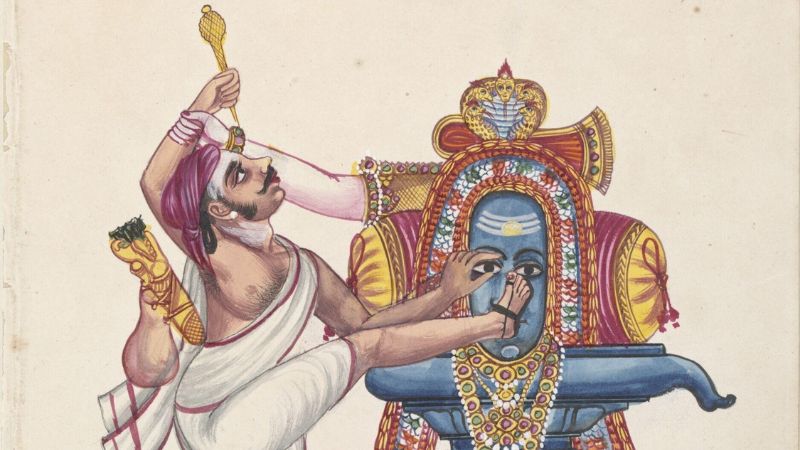
The legend of Kannappa Nayanar is an evocative reminder that the relationship between god and devotee needs to be unhindered. Kannappan, a hunter, fed his Siva the meat from his hunts. He collected water in his mouth and spat it on the linga to bathe his Siva. Siva was decorated with the flowers that Kannappan plucked and carried in his own hair. Kannapan did not know that his every action threw brahminical rules of ritual to the wind. This was his offering, his personal relationship with his lord. The lord had no right to refuse. One day, Kannappan found that his Siva was bleeding from one eye. Unable to stop the bleeding, Kannappan gouged out his own eye and placed it on the lord’s. Soon, the linga’s other eye began to bleed. The only way to remove his own remaining eye and offer it to Siva was to use his foot as a place-marker on the linga as he gouged his eye out with an arrow. In the tale, Siva is testing the devotee. An elucidation of bhakti, this is also a story about being free, free from the fear of judgement. Kannappan decided how he would pray; that right was not just freedom, it was dignity. This dignity was born from devotion. Every religion has stories of society shunning people who surrender to god in the manner of their choosing. And one need not be a saint to have this right.
*****
This excerpt from We, the People of India: Decoding a Nation's Symbols by TM Krishna has been published with permission from Westland Books.
 souk picks