

Mothers & daughters: A reading list
Editor’s note: The relationship between mothers and daughters can be sweet, loving, and tender. And it can be fraught, acrimonious, messy, combative. All together. Arundhati Roy, in her powerful memoir from last year, referred to her late mother as “my shelter and my storm”. In Darling Rose Gold, inspired by a horrifying real-life story, a seemingly perfect mom deliberately makes her daughter ill for attention. Rosarita, Anita Desai’s 2024 novella, is about a young woman who realises how little she knew her mother.
In this fascinating reading list, Sneha Pathak looks at 10 fiction and nonfiction books that reckon with the complexities and emotional push-pull dynamics that play out in mother-daughter relationships—from guilt to anger, neglect, resentment, abuse, and sadness.
Written by: Sneha Pathak
*****
Girl in White Cotton (Burnt Sugar) by Avni Doshi
This superb debut by American author Avni Doshi (born to Indian immigrant parents) is the story of Antara and her mother, Tara. Tara walked out on her marriage to live in an ashram, eschewing the conventional roles of ‘wife’ and ‘mother’. In the process, she neglected her daughter. The novel, set in Pune, presents the story of her artist daughter, Antara—still scarred by her erratic childhood—as she watches her mother’s decline due to dementia, and becomes her caretaker. Girl in White Cotton (or Burnt Sugar for international audiences)—which was shortlisted for the 2020 Booker Prize—is about the tangled emotions emerging from this fraught relationship; it’s written entirely from the perspective of Antara, who might not be the most reliable of narrators herself. The Guardian, in a review, called it “painfully exhilarating” and a “thrilling ride into hell, where ordinary scenes have a nightmarish quality”.
The Far Field by Madhuri Vijay (2019)
The Far Field, another thrilling debut, was the 2019 winner of the prestigious JCB Prize for Literature. Thirty-year-old Shalini, leading a comfortable life in Bangalore, heads to a village in Kashmir on a quest—she wants to understand her mercurial, and often volatile, mother better after her death. She wants to understand the impulses that governed her. And in this desire to know her, she finds herself in search of a salesman named Bashir, who used to visit them when Shalini was a child.
Her personal grief and curiosity about her mother’s past life collide in this electric novel with the politically fraught land of Kashmir, which has its own complex dynamics of belonging and conflict, and Bashir’s own family history. “…Vijay’s command of storytelling is so supple that it’s easy to discount the stealth with which she constructs her tale, shifting time frames with seamless ease and juggling a wealth of characters who cling to the heart,” wrote The New York Times. Shalini’s rash, careless decisions while she’s there end up impacting the people around her, destroying and upending the lives she comes into contact with briefly.
I’m Glad My Mom Died by Jennette McCurdy (2022)
Jennette McCurdy, former child actor, writes this poignant memoir about her career and the complicated relationship she shared with her mother, Debra, a classic ‘stage mom’ foisting her expectations on to the precocious young child. McCurdy, who became famous for her stint in the mid-2000s as a character on the sitcom iCarly, entered the industry because her mother wanted her to. From the outside, she was a successful Nickelodeon star; from within she was battling abuse, neglect, anxiety, addiction, and an eating disorder. It’s only after her mother died of cancer that she realised the impact of years of being controlled by her mom. The book is split into ‘Before’ and ‘After’ sections, to acknowledge Debra’s death, and sees McCurdy describe her journey through acting, which began at the age of six, as well as a brief musical career, in addition to her relationship with Debra. She is no longer an actor, and has released Half His Age, her debut novel, this year.
Bougainvillea House by Kalpana Swaminathan (2006)
Clarice Aranxa is dying, and she has chosen Bougainvillea House in Goa for this purpose, in this psychological thriller by Kalpana Swaminathan. After all, this is the house where her husband died mysteriously, making her a young widow with two small daughters. Now, she is dependent upon her younger daughter, Marion, who, along with housekeeper Pauline, try to take care of her. The book describes the story through Clarice’s voice in the first half, as more deaths occur and Clarice’s condition takes a turn for the worse, with her doctor, Liaquat Ali Khan, trying to figure out what’s going on.
But Bougainvillea House has its secrets and, as the memories begin to rise again, the relationship between Clarice and Marion undergoes a dramatic change, resulting in a shocking, explosive finale. A novel that defies conventions of the genre and explores the darkest corners of the human mind, Bougainvillea House will appeal to those who like their thrillers literary.
Rosarita by Anita Desai (2024)
How well do we really know our mothers? This is the question at the heart of 2024’s Rosarita by acclaimed author Anita Desai (which even found a spot on Barack Obama’s 2025 summer reading list). Bonita, an Indian woman, is in Mexico to learn Spanish. She’s sitting on a bench when an elderly woman approaches her, mistaking Bonita for her mother. Bonita is convinced the stranger didn’t know her mother; there’s no way that the stories she narrated of her are true. Her mother couldn’t possibly have been a painter who came to Mexico to study art. That’s not how she remembers her. But as Bonita follows her, she realises that there were parts of her mother—‘Rosarita’, as the woman calls her—she might not have known. The novel deepens the mystery, refusing to provide any concrete answers to Bonita; but it is a reminder of how little we might know the person behind the parent. Wrote The Guardian in a review:
Written in the second person, the novel interrogates the gulf that can exist between a parent and her child, and the sketch – forgotten and recalled – is a sly mise en abyme that also speaks to the fickleness of memory, and the ever-porous boundaries between the past and the present.
Mother Mary Comes to Me by Arundhati Roy (2025)
Arundhati Roy’s relationship with Mary, her towering and volatile mother who, in many ways, shaped her, lies at the heart of her much-lauded new memoir, Mother Mary Comes to Me. It tells the story of the fierce and free-spirited woman whom Roy calls “my shelter and my storm”. The New Yorker describes the impact she had on Roy:
Roy recalls her mother’s hypercritical gaze as an act both of creation and of demolition: “It felt as though she had cut me out—cut my shape out—of a picture book with a sharp pair of scissors and then torn me up.” She learned early the futility of trying to please or appease. What she absorbed instead was the power of unyielding dissent. From the moment Roy could walk, she was marching in step with a formidable rebel.
Written after Mary’s death in 2022, the book is a testament to the complex, ambivalent bond between the two, and how, sometimes, distance can go a long way to sustain the love one has for an influential figure in their life, and Roy, in her typically forthright style, confronts a complex algebra of contrasting emotions here.
Darling Rose Gold by Stephanie Wrobel (2020)
Rose Gold spent the first 18 years of her life in and out of hospital. She was led to believe she was seriously ill, and no amount of investigation would reveal what was actually wrong with her. Too sick to go to school, make friends, lead an ordinary life, her mother became her whole world. Until, that is, she learns that her own mother, Patty Watts, had been making her sick.
After Rose gets help, Patty is sent to prison for five years for child abuse. Upon her release, Rose is willing to let Patty into her life again. Is it because Rose has forgiven her, or is there something else beneath the surface? Told in alternating perspectives of Patty and Rose, both of whom are unreliable narrators, Darling Rose Gold is a remarkable debut by Stephanie Wrobel—drawing from the shocking real life story of Dee Dee Blanchard and her daughter, Gypsy, reported by Buzzfeed—that peers unblinkingly into the dark, bleak corners of the human psyche and tangled relationships.
Are You My Mother? by Alison Bechdel (2012)
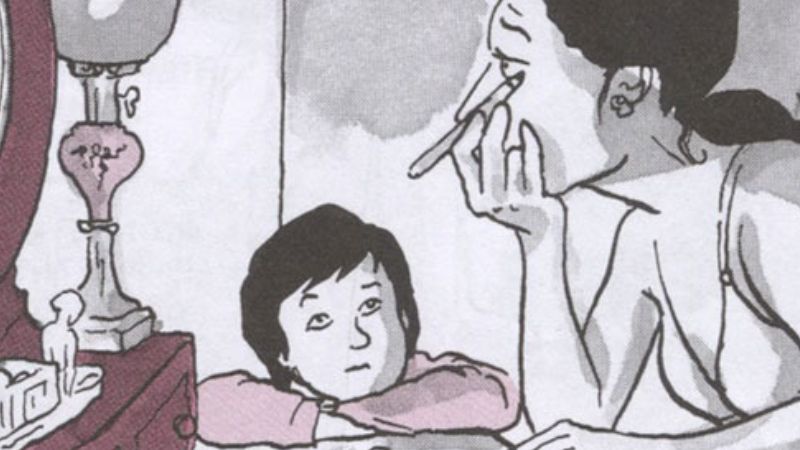
American cartoonist Alison Bechdel received acclaim—both critical and commercial—for her 2006 graphic memoir Fun Home, in which she examined her relationship with her father. Are You My Mother?, published in 2012, is a follow-up of sorts to that; here, she delves into her relationship with her mother, who harboured artistic aspirations herself, blending memoir with psychological exploration and psychoanalysis.
Leading an unfulfilled life and caught in a marriage with a closeted gay man, she created a distance between herself and her daughter. This distance is what Bechdel humorously ponders over, along with her own professional and personal struggles as well as her mum’s discomfort with Fun Home for revealing family secrets to the world.
It’s a sharp and intimate work where Bechdel reckons with her own memories of the past and the toll that certain events can take on the family. As she told The Paris Review in an interview:
There’s so much she hasn’t told me, and so many big obligatory questions that I didn’t touch on in this book. Like, what has it been like for my mother to live with the pain of her husband’s suicide? I can’t ask her that. I can’t even raise that question in the book, because that’s too painful. So in a way the book is constructed around these big gaping absences.
I’m Supposed to Protect You from All This by Nadja Spiegelman (2017)
Nadja Spiegelman’s memoir is about the intergenerational burdens we carry. As a child, Nadja was her mother’s biggest fan. But their relationship changed after Nadja reached puberty. As her mother recounted the story of her own relationship with her mother, Nadja sensed a pattern. She decided to move to Paris, where her grandmother still lived. And it was through knowing her grandmother that she realised how family ties can be knotty and memories fragile. The result is a book that will resonate with anyone haunted by why they behave in the same way their mothers did, despite having sworn not to.
A Mirror Made of Rain by Naheed Phiroze Patel (2021)
Naheed Phiroze Patel’s debut is a powerful coming-of-age novel about Noomi Wadia, a privileged young woman from an upper middle-class Parsi family in India, and her troubled relationship with Asha, her mother. The book is a contemporary reflection on class, society, and abusive familial dynamics. Asha is a heavy drinker and smoker who doesn’t seem to care much for her daughter. Growing up in this cauldron of abuse and neglect, Noomi too finds herself caught in the same cycle as her mother, turning to alcohol for solace and developing a problem. Even as she navigates life and her mostly loveless marriage, the image of her mother continues to dominate her thoughts and actions. This dark, hard-hitting novel is a look at how addiction can ruin lives and relationships across generations and how easy it is to get caught up in destructive patterns.
*****
Sneha Pathak is a freelance writer and translator. Her works have appeared in The Telegraph, Deccan Herald, Strange Horizons, and The Chakkar. You can follow her on Instagram.
 souk picks