
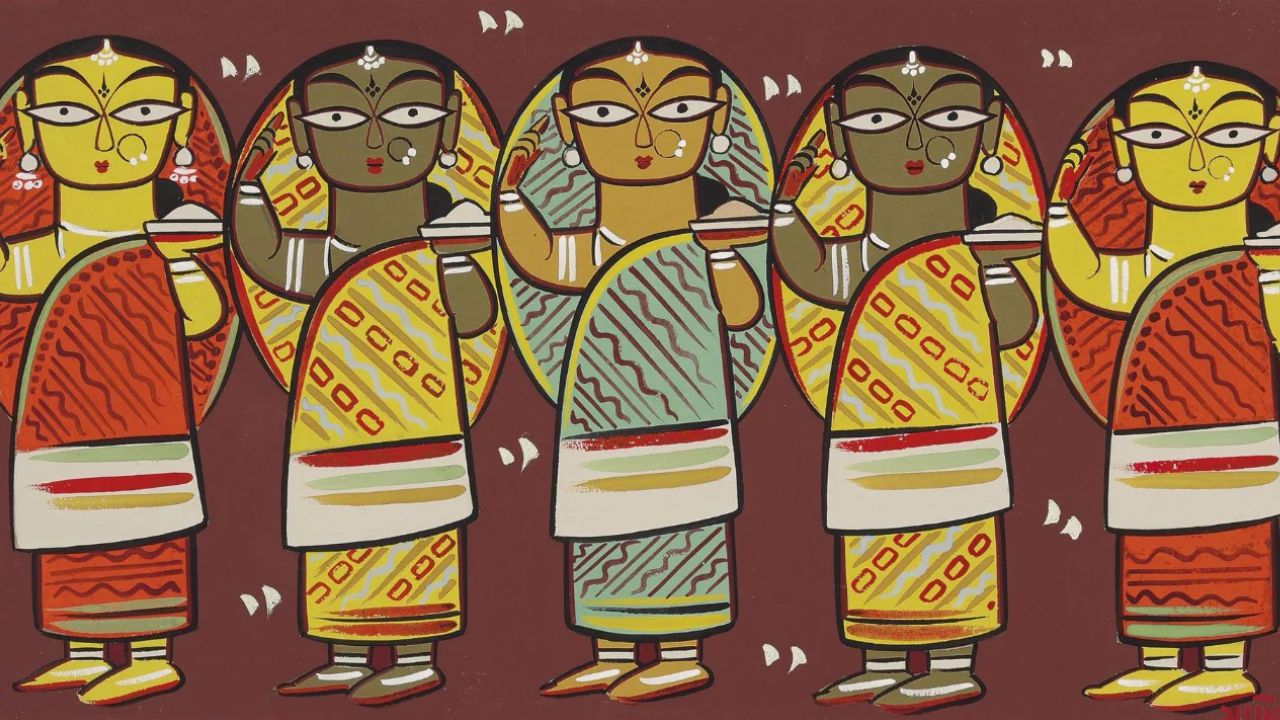
Jamini Roy, Master Moshai
Editor’s note: Modernist painter Jamini Roy (1887-1972) created a fresh, unique, democratic art practice, drawing inspiration from Bengal's rural and folk traditions. Trained in European traditions, Roy decided his own path, and fashioned a radical style both the keen and the casual eye will still find today across—museums aside—cafes, bungalows, T-shirts, and mugs.
Roy’s model of creating multiple copies of his art via his assistants and selling them directly from his studio is a practice still alive in the world of Instagram marketplace. In this essay, Advisory Assistant Editor and art enthusiast Mekhala Singhal looks back on the artist of the people: how he came into being and what he means in the present.
Written by: Mekhala Singhal
*****
In his poem 'Jamini Roy Ke' (To Jamini Roy), modernist Bengali writer Buddhadev Bose wrote that while everyone was wrecked with guilt and dwelling in self-pity, Roy poured his heart into 'Jiboner rosh' (the nectar of life), burning his life from the flame of art. Indeed, Roy was one of a kind.
Depending on where you lie on the scale from ‘bare minimum interest in the arts’ to ‘intense, serious love for art’, you may or may not have heard of his name. Without a doubt though, you’ve seen his work. I say this with confidence because Jamini Roy’s style of painting, rooted heavily in Bengali folk art traditions, is unmistakably distinct and recognisable: almond-shaped eyes, broad shoulders, bold, flat colours. Today, you will find Roy’s art not just in museums but across drawing rooms, cafes, T-shirts and mugs.
Who was Jamini Roy—and what led him to creating this signature style? Today, on his 139th birth anniversary, we celebrate Jamini Roy through his art, and take you through his life and work.
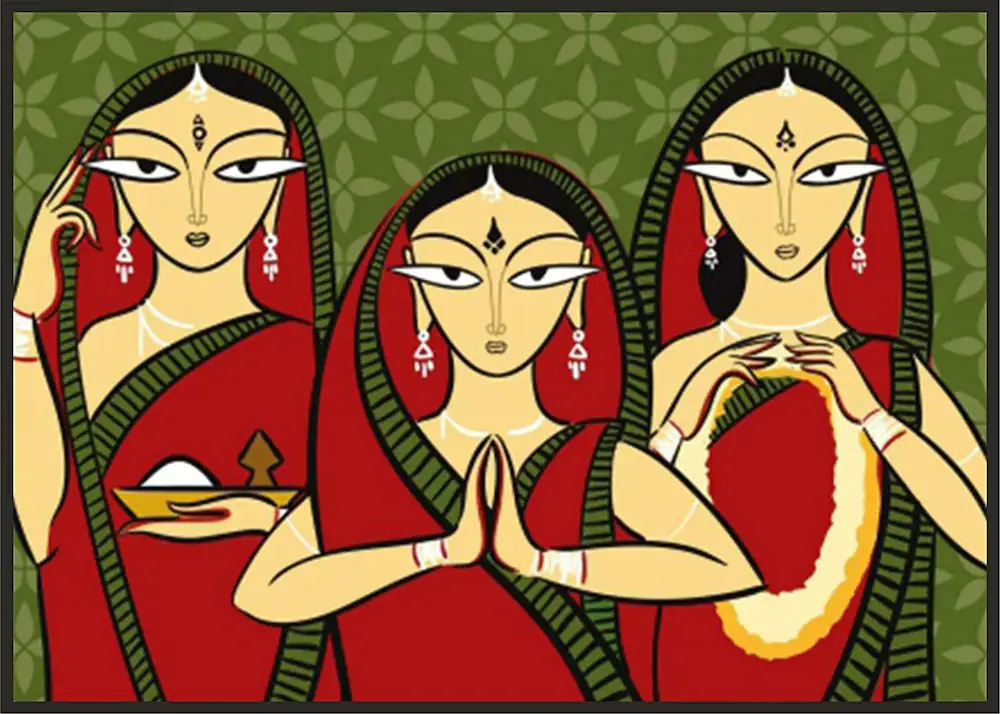 Three Worshipping Women
Jamini Roy was born on April 11, 1887, in a village in Bankura district of undivided Bengal. Legend has it that Roy, in the course of rejecting the urban artistic institutions he first studied in and later rejected, would frequently bring up his native village Beletor as what truly exemplifies "Indian".
At the age of 16, Roy moved to Kolkata to study at the Government College of Art. There, he studied under the reformer Abanindranath Tagore, known for founding the Bengal School of Art in the first half of the 20th century. The Bengal School—nationalist and anti-colonial in spirit—was an art movement that rejected European-style realism and emphasised on indigenous Mughal, Rajput, and Ajanta traditions.
Fun fact: Abanindranath Tagore was a nephew of Rabindranath Tagore!
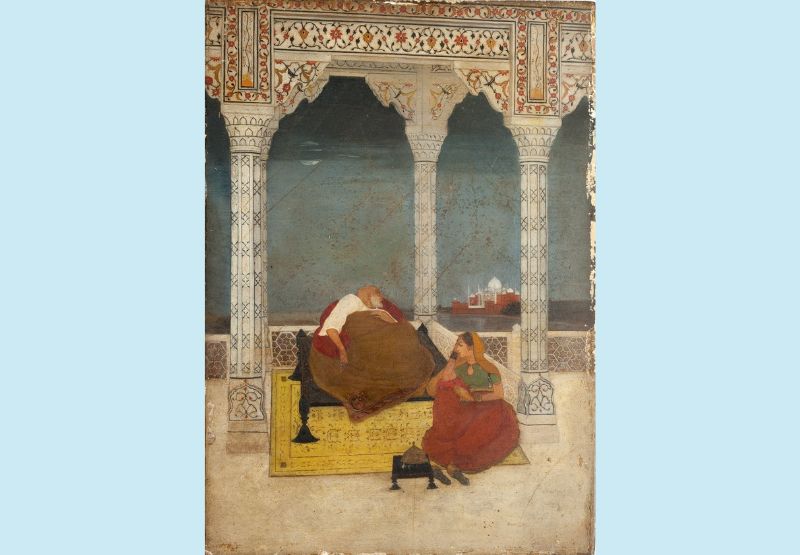
The Passing of Shah Jahan, Abanindranath Tagore, c. 1902
The Bengal School laid the groundwork for the Indian Modernist art era, of which Roy became a crucial part, alongside Nandalal Bose, Amrita Sher-Gil and MF Hussain. Once Roy completed his studies, he started working as a portrait painter. Trained in European realist styles, Roy’s post-impressionist oil paintings gained him much appreciation and started his career.
But over time, in conjunction with both his anti-colonial stance and the drive to find his own voice, Roy felt the need to reject and move away from these conventions. He grew impatient, and felt the need to incorporate indigenous folk influences. By the 1920s, he began experimenting with softer oil painting. During this time, he also grew particularly interested in the Santhal tribe, and would even paint the women from the tribe going about their daily lives.
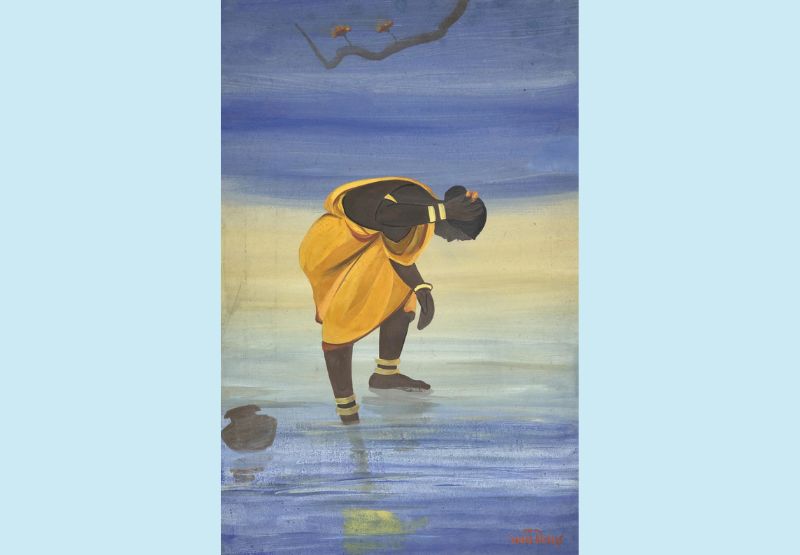
Santhal Girl
He started to explore ‘pattachitra’ (scroll paintings using natural dyes) and began to embrace the style of folk art traditions, particularly the motifs from the Patua community's Kalighat paintings, from where he drew his signature bold, sweeping strokes, the elongated eyes, etc.
Roy started borrowing themes from these paintings, such as mythological characters, Hindu gods, and playful caricatures of a variety of animals. As time went on, he leaned into this style, slowly forgoing his oil paints. Roy began using more natural, traditional paints made from organic sources.
Like the patua painters of Bengal, he relied on indigenous materials such as lampblack, chalk powder, leaves, and creepers, employing a palette of seven fundamental colors: Indian red, yellow ochre, cadmium green, vermilion, grey, blue and white.
Flat textures and colours made his pieces stand out, especially when combined with unconventional surfaces like wood and cloth. He stuck to his two-dimensional depictions in alignment with the traditions of the Patuas.
See Delhi Art Gallery’s video on Kalighat Patua paintings:
Following their path, Roy also mass-produced his artwork using assistants who were part of his workshop. The idea was to dismantle the concept of the lone, genius artist and practice communal artmaking. This is one reason Jamini Roy is still so accessible today.
Thus, Roy moved away from both the European realist school and Abanindranath Tagore’s Bengal school and found a third path rooted in folk art and his own personal journey.
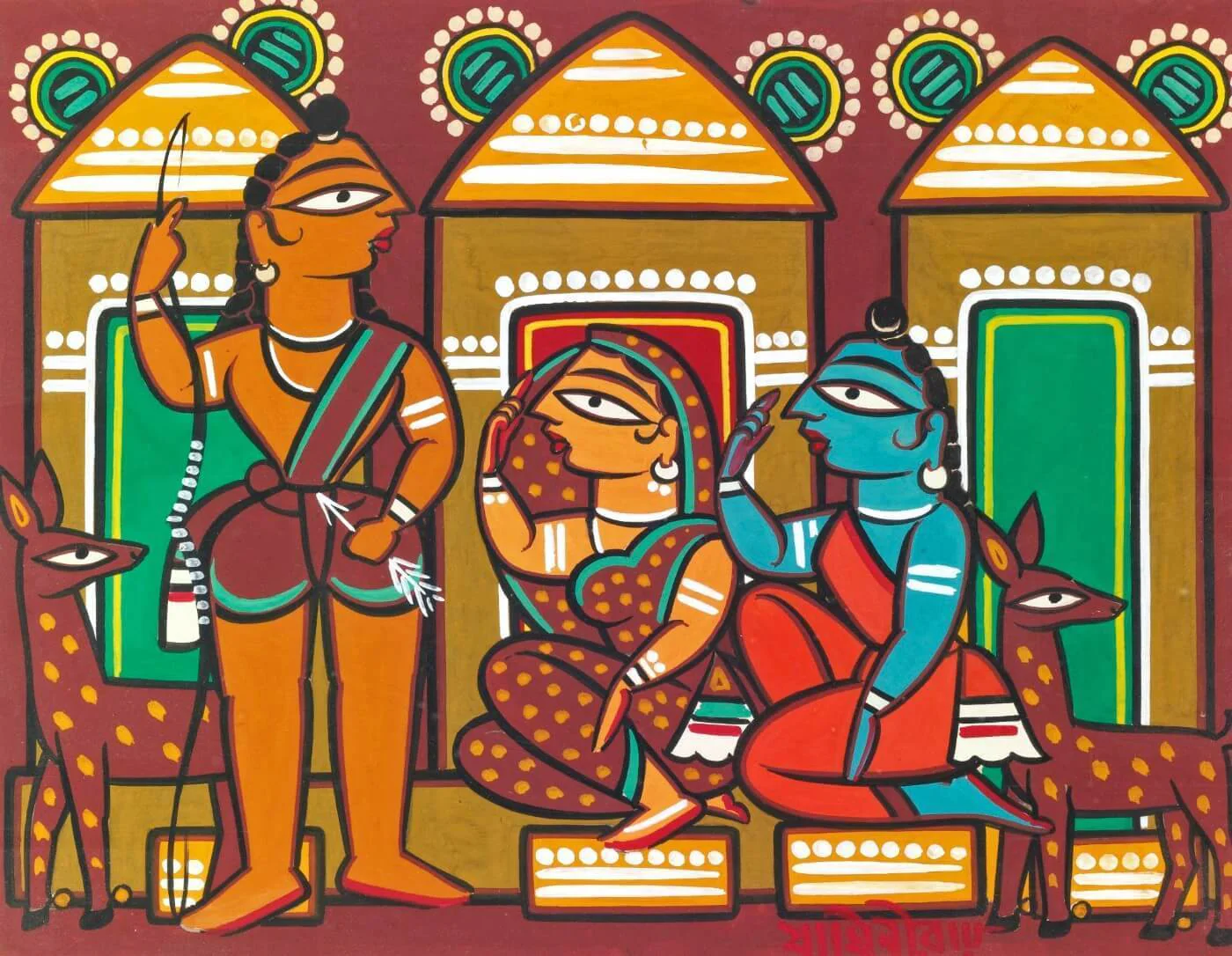 Untitled (Ram, Sita, Lakshman)
The themes in Roy’s work are varied. When it came to Hindu mythology, he was drawn to the epics. His series of 17 interconnected paintings on Ramayana, done in 1946, is his crowning achievement.
Roy also focused on Christian art and motifs, and moments from rural Bengali life. He depicted everyday lives of labourers, artisans, children at play. He spent time imitating children’s art and the art of the folk dolls. He was especially interested, as mentioned earlier, in the lives of the Santhal tribe—their daily lives, their music and art, their traditions—and the joys and habits he observed in their people.
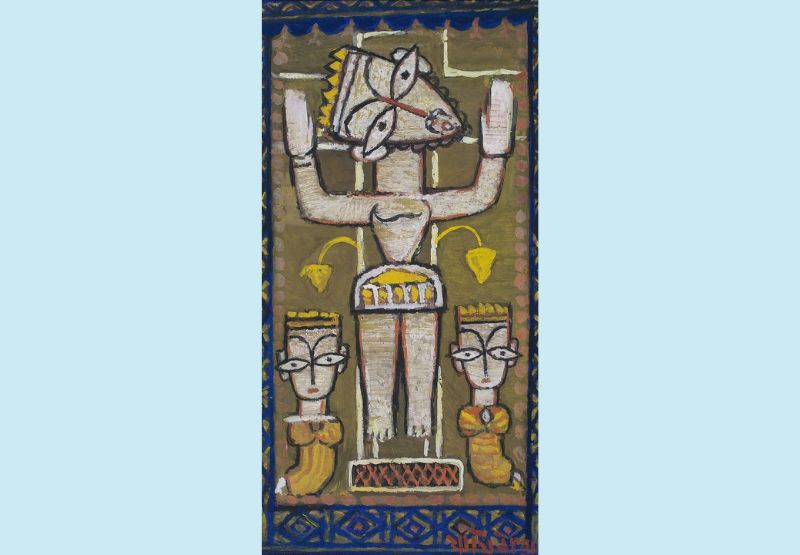 Untitled (Crucifixion)
Fun fact: In 1949, Jamini Roy began designing his own home, a bungalow in Ballygunge Place in Calcutta. With glass panelled staircases, open spaces, and big windows, he turned that home into both his residence and his studio. This house is where he lived until his death in 1972. In 2024, it was converted into a museum of his art by the Delhi Art Gallery.
Jamini Roy’s contributions to Indian Modern art are incomparable. In rejecting the formal, popular style of the time, he made space for artists to embrace innovation and experimentation. The fact that he focused on not just gods and goddesses (and Jesus Christ, of course) but also the lives of everyday people and animals in his art made his paintings relatable and grounded in the reality of the India in which he grew up.
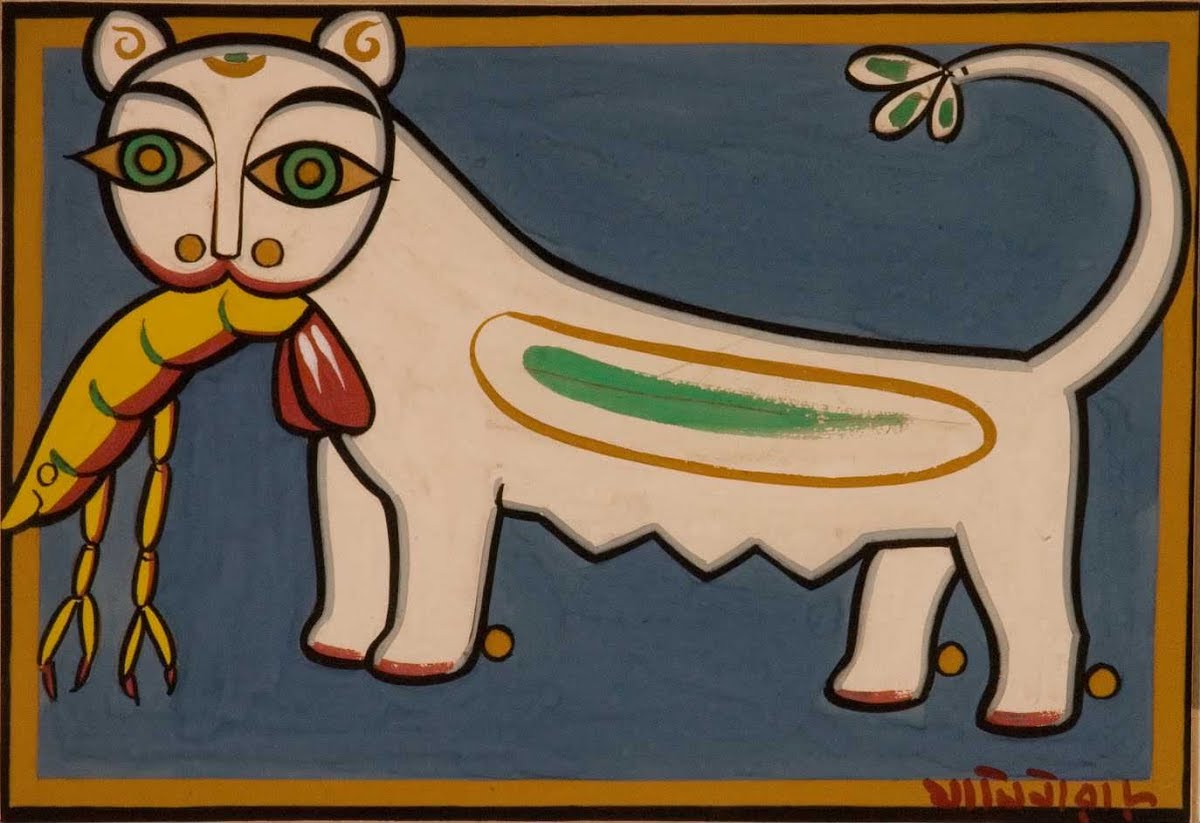 Cat with Lobster
His work has since been adapted—from his line work, to his technique, to his love for flat colours—by several artists. In 1954, he was awarded the Padma Bhushan.
Fun fact: Roy’s works were declared national art treasures in 1976, making him one of only a few Indian artists whose works cannot be exported out of the country.
A student who Roy mentored once wrote:
Master Moshai often spoke of the importance of rooting oneself in one’s own culture. “To understand the world, you must first understand yourself and where you come from,” he would say. He believed that true art was born when one’s personal experiences intersected with the world’s vast expanse.
*****
Mekhala Singhal is Assistant Editor at Advisory.
 souk picks