

Beatings, barricades & women fighting back
Editor’s note: The past few months of anti-establishment protests have seen lurid visuals—bordering on sexual violence—of women being manhandled, groped, and carried away by the authorities. In our lead essay this week, Ishita Sengupta looks at the female body as the site of much contestation, and how women have, in turn, tried to reclaim the public square via that very means.
Written by: Ishita Sengupta
*****
During my five years in college, I diligently followed the three things my mother asked me to do: reach home early, call her if I am late, and never take part in protests. The institution I studied in, Presidency University, is situated in a busy neighborhood in North Kolkata and has had a long history of protests. Across time, the place served as the focal point of uprisings, most noteworthy being the Naxalbari Movement in the 1960s. By the time I walked inside the premises, the intensity of dissent had dimmed to college unions, elections, and faded graffiti on the walls. Even then, I wholly subscribed to my mother’s views. You see a group of students rallying for something, you stay in your classroom. Cut to a decade later, now living in Mumbai, I have abandoned her trusted advice. Every time there was a clarion call of defiance this year, I took to the streets.
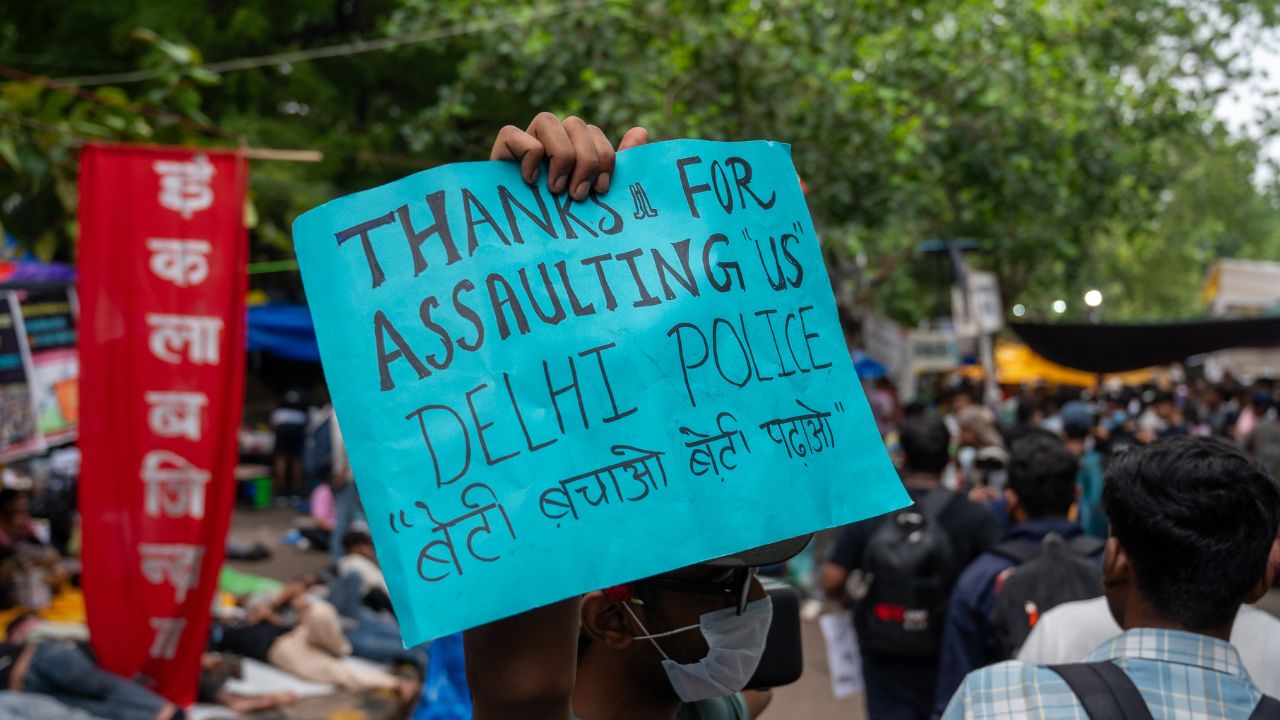
It might be tempting to read this as disobedience, but there’s a larger context here. In the last few months, as one uprising followed another in India, there have been recurring images of women’s bodies being grabbed, hounded by male and female cops, and dragged to detention. The visceral sights have prompted discussions about police brutality, sexual abuse, and unlawful abuse of power. But within the crevices of conventional discourse, lay another narrative: women asserting control of and in public spaces—persuading more women to join in by using their bodies as weapons of rebellion. Women like me.
It is a thorny argument to make, but equally impossible to unmake. This year, the imagery of women partaking in protests with the full might of their bodies, being penalised for it, and yet continuing to do so created an undented spectacle of bravery. ‘Spectacle’ because, though not wholly atypical, the image was disruptive in its persistence of recreation. A woman’s body is seldom treated as her own. In private, it is often trained to be in service of others; when outside it is rendered vulnerable to submission through violence. In other words, women’s bodies have historically been treated as instruments that can be, and are, wielded against them. Yet in the past months, as they kept showing up despite threats and harassment, women fulfilled the possibilities of launching a counter-attack through those very instruments, declaring thereby an ownership over themselves.
Women at the forefront of protests in India have been common, from the Chipko movement in the 1970s, aimed at forest conservation, to the anti-CAA protests when women did continuous sit-ins at Shaheen Bagh as part of opposing the Citizenship (Amendment) Act, 2019. Even so, something felt different this time. It could be recency bias; it could be the fact that seeing the youth of the country rise after a pandemic had lulled the nation to an apathetic frenzy felt unprecedented. Or maybe it was just me. Maybe it was in the air.
In March, protests broke out in different parts of the country against the Transgender Persons (Protection of Rights) Amendment Bill, 2026; July witnessed even bigger mobilisation of Gen Z, spearheaded by the Cockroach Janta Party (CJP), a youth-based activist movement—they sought and achieved the removal of the education minister Dharmendra Pradhan over the NEET exam paper leaks. In September, hundreds of women in Delhi protested against the alleged gang-rape of a 17-year-old, and October and November were filled with rallies organised by opposition parties to oust Chief Election Commissioner Gyanesh Kumar, after an Indian Express investigative report revealed that he took unilateral decisions regarding the electoral roll database despite concerns raised by his fellow commissioners, thus allegedly interfering with the fairness of the electoral process.
Visuals played a key role through it all. As people took to the streets, they were met with indiscriminate coercion. Many were shoved inside police cars, physically harmed. Images of resistance flooded not just traditional media but social media. Students, activists, leaders, journalists took it upon themselves to self-document the horror that unfolded, and soon apps like Instagram and X (formerly Twitter) were enlivened with a collective cry of dissent. Although such image-making carries the risk of romanticisation, it contains grains of courage. The perverse poetry of it all had striking upshots. In one, a woman stood in front of a police van carrying detainees, refusing to budge till those in uniform relented. In others, young boys and girls fought back as cops tried silencing them. Rage simmered and, somehow, by the end of the year, took concrete shape. As India rose to protest again, citizens retaliated against government tactics, like temporarily shutting down metro stations, to withhold them.
While the protests I went to in Mumbai were marked with heavy police surveillance and largely peaceful detentions, in Delhi it was a different story. Social media was replete with videos of young protestors being surrounded by cops and dragged on the road like wooden toys prone to crumbling with force. Neha Bora, the 29-year-old activist leader, is an example. Bora has been at the centre as a crusader of public fury. They have been grabbed, groped, and pushed inside police vans; their body subjected to singular intrusion, put out on display almost as an example for the rest to learn from. At Jantar Mantar, female students were aggressively pushed inside buses to halt demonstrations. In turn they clung to the doors of the vehicles, huddling and shouting out slogans together. In other instances police officers could be seen running and cornering female protestors and physically pulling them—by their arms, legs and even hair—across the road. These images remain provocative and compelling; the defiance they carried offered responses to critical queries like. ‘What can be done to women’s bodies? And what can they do?’
The lack of compulsion to aestheticise such disobedience has created a necessary fissure in the consumption of bravado. Although activism is not a male-centric preoccupation, the offshoots of it, like courage and pride, are traditionally appreciated only through gendered lenses. For instance, Leader of Opposition Rahul Gandhi climbed atop a police barricade, his brawny silhouette offering a definitive image to the demonstrations. But before Gandhi, Bora had done it. Yet, the former was applauded for his resilience and the latter valued for subversion. Despite Bora’s non-binary identity, they are read by the public and the media as a woman, often being misgendered in the process; still, the unequal physicality of genders is built into this interpretation of resistance, defining the varying expectations from them. By laying their bodies on the road and refusing to bow down despite intimidation, women and other genders seem to have aligned bravery to the conventional understanding of it, and with that, freed the rest to behave.
This misbehaviour is both compelling and inviting. For many, me included, such gestural politics became a path to channel the rage that we felt in our bones. Protest sites, occupied by multitudes, became spaces to voice what we wanted, and warranted us the freedom to be versions of ourselves that, through adversities, also felt inexplicably sheltered due to solidarity.
Women’s relationship with their bodies has been long explored. Reflecting on this, American theorist Iris Marion Young in her 1980 essay, ‘Throwing Like a Girl’, wrote, “Women often approach a physical engagement with things with timidity, uncertainty, and hesitancy. Typically, we lack an entire trust in our bodies to carry us to our aims.” She added, “We have more of a tendency than men do to greatly underestimate our bodily capacity.” It is self-explanatory how the last few months defied this idea while also doing something else. They recalibrated, recentred, and readjusted women’s relationship with public spaces, deeming the roads and the rage to be, for once, her prerogative. And with that, the protests—like female-fronted rebellions in the past—served as a rite of passage for several women, some who have been afraid and some who inherited that fear. Some like me and some like my mother.
*****
Ishita Sengupta is a film critic and culture writer. She is Consulting Editor at Advisory. Her work is informed by gender and pop culture.
 souk picks