

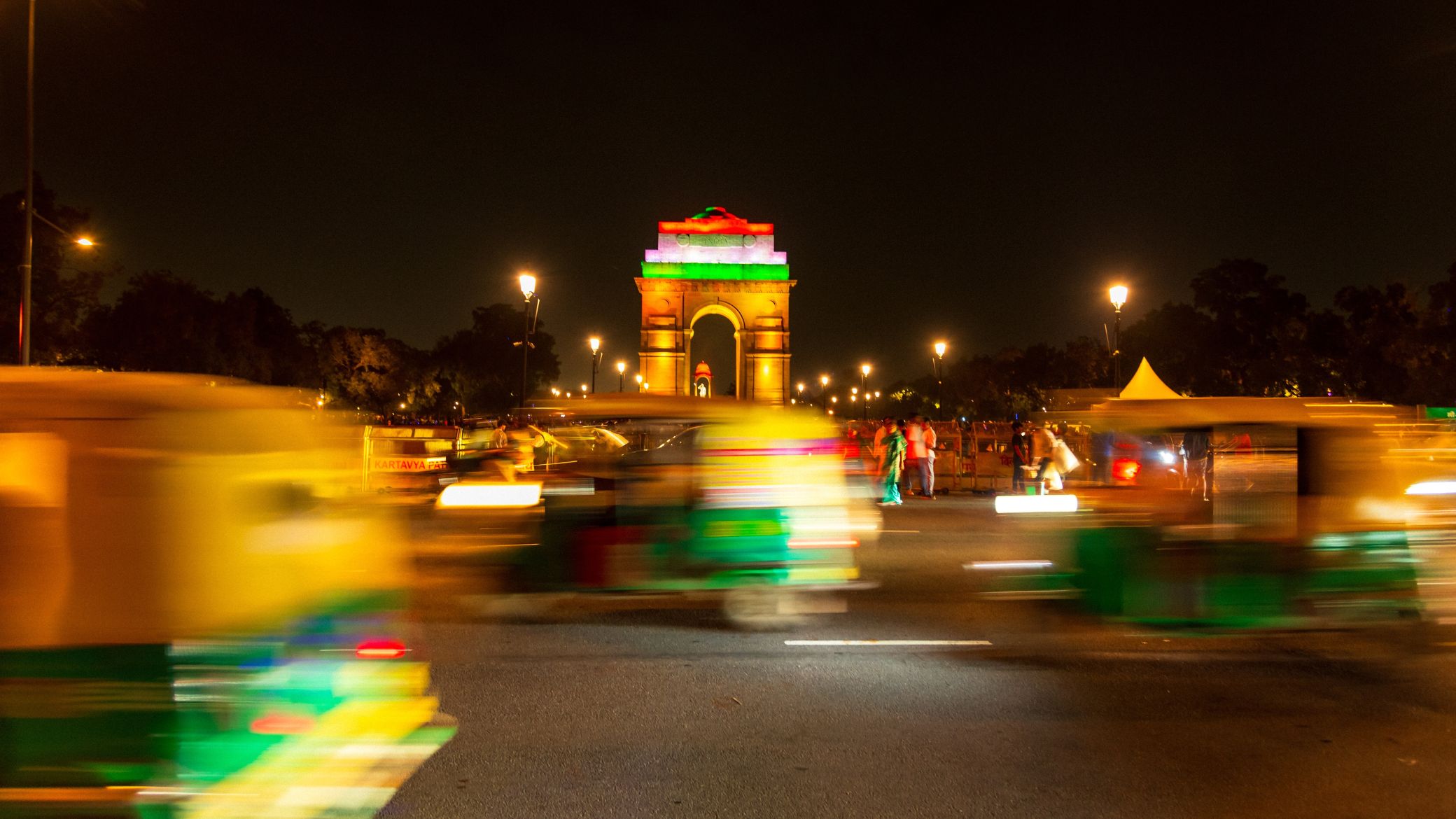
India’s main character moment
Editor’s note: As we get ready to celebrate 79 years of independence, here is a very special reading list by Amritesh Mukherjee of books featuring India as a central character in the narrative. From Gora by Tagore to Salman Rushdie’s Midnight’s Children or The Ministry of Utmost Happiness by Arundhati Roy, these 10 books bring to life the many pluralities of a nation as lively and diverse as India.
Written by: Amritesh Mukherjee
*****
Is a nation a boundary, a geographical line drawn across lands and rivers separating people and cultures? Or is a nation a people? And if so, is the nation a character in the lives it contains, too? Just as its populations shape its history, culture, present, and future, does it, in turn, shape its inhabitants?
Indian writers have long personified the nation as Mother India or Bharat Mata—a sacred motherland goddess embodying the country's soul. The concept was popularised in literature by Bankim Chandra's Anandamath and the song ‘Vande Mataram’ within it.
Across genres and generations since, India has often appeared as a character itself: a landscape containing a past and a future, a spiritual essence that defines and is defined by its people. The works below do the same, whether literally or as a looming backdrop, using symbols and allegory to explore what India is and what it ought to be.
Anandamath by Bankim Chandra Chattopadhyay (1882)
Set during the late 18th-century Sannyasi rebellion and the Bengal famine, Bankim Chandra's Anandamath is the story of Mahendra, a young zamindar who loses his family, and of Kalyani, who fights against British oppression. They join the Sanatanas, a sect of Sannyasi freedom fighters serving their motherland. Within the novel, three idols represent Bharat Mata: the mother in past glory, in present suffering, and in future redemption. These successive images personify India as a goddess to be worshipped and liberated.
The novel introduced the song ‘Vande Mataram’ to the national consciousness, literally meaning "I bow to thee, Mother." Considered the first song to imagine India as a motherland, it envisions the nation not merely as a setting but as a spiritual presence permeating the essence of its citizens. Combining Hindu myths and historical fiction with devotional undertones, the novel captured the rising nationalist sentiment and inspired many patriots. At the same time, it also created a conflicted legacy by encouraging religious extremism.
Gora by Rabindranath Tagore (1910)
A classic of Bengali literature, Rabindranath Tagore's Gora explores nationalism through its protagonist, Gora. He is a young man raised as a Hindu Brahmin, who is patriotic, yet casteist and religiously dogmatic. Through his friends, family, and circumstances, he is eventually forced to grapple with his beliefs and with what being an Indian means.
Via this journey toward a more expansive idea of belonging, of inclusivity, tolerance, and universalism, Tagore personifies India as an inclusive mother. Gora's wise adoptive mother, Anandamoyi, symbolises the compassionate Bharat Mata, one who embraces all her children regardless of wealth. Throughout the novel, Tagore presents his own vision of India: one that goes beyond narrow identities, a nation secular and plural.
Panchali Sabatham by Subramania Bharati (1921)
An epic Tamil poem by the nationalist poet Subramania Bharati, Panchali Sabatham (or Draupadi's Vow) was written during the Indian independence movement and retells the Mahabharata episode in which Draupadi is gambled away and vows to avenge her humiliation. Bharati uses this mythic scene to allegorise colonial India, in which Panchali is Bharat Mata and the dice game represents British oppression.
Just as Draupadi is humiliated by the Kauravas, India suffers under imperialists. Using Hindu symbols such as goddesses and the yajna fire, the poem draws parallels between the Kurukshetra War and the Indian struggle for independence. Like Bankim Chandra, Bharati imagines the nation as a goddess and urges freedom fighters to rally around her and avenge her humiliation. In doing so, Panchali Sabatham reimagines the colonial struggle as a sacred pursuit, a moral duty of its citizens.
Kanthapura by Raja Rao (1938)
One of the first Indian English novels, Raja Rao's Kanthapura is a rural epic set in the fictional village of the title, narrated by the grandmother, Achakka, as a harikatha (an oral storytelling tradition). It tells the story of village folk awakening political consciousness to the Independence movement, mobilised by a young Brahmin schoolteacher, Moorthy, a fervent follower of Gandhi. The book advocates for caste equality and captures the tension between tradition and modernity.
When the local feudal lords support the British, Moorthy goes against them through non-violent satyagraha, leading to conflicts and displacement for the villagers. In that way, the village becomes a stand-in for India: poor and oppressed, yet spiritually rooted, non-violent, and echoing ideals of liberation and cooperation. The paddy fields, temples, village gatherings, myths, and history embody and convey the essence of the nation.
Midnight’s Children by Salman Rushdie (1981)
A landmark postcolonial novel, Salman Rushdie's Midnight's Children (a Booker favourite) is the story of independent India via its narrator, Saleem Sinai. Born exactly at midnight on August 15, 1947—the moment India gained independence—Saleem's life allegorises modern Indian history, from the Partition to the Emergency. Saleem discovers that he can telepathically connect with hundreds of other midnight children born during that first hour of independence, each representing a different region, language, or faith of the new nation.
For instance, his adversary, Shiva, illustrates violence and conflict. Rushdie brings together history and myth in a personal family saga, with conflicts mirroring Nehruvian India, the Partition, the Emergency under Indira Gandhi, and the period that followed. Like the mood of the nation, the novel is simultaneously exuberant, witty, surreal, magical, and depressing. With these characters and their voices, the nation becomes a character in its own right, shown in all its cultural and political diversity.
The Shadow Lines by Amitav Ghosh (1988)
A multi-generational saga on memory and nationalism, and the many lines that divide nations, Amitav Ghosh's The Shadow Lines follows the family of an unnamed Bengali boy. Set alternately in 1960s Calcutta and 1980s London, the novel enters the world of the middle-class Datta-Chaudhuris and their English friends, such as Tridib and Ila. Even though historical events—like the Second World War, the Indian freedom movement, the 1947 Partition, and the 1964 communal riots in Dhaka—play out against the backdrop, we see them through personal memories.
The novel emphasises how borders are mere shadow lines: lines visible only to some. India here may not be a personified deity, but it is a concept under scrutiny. On one hand are the geographical and political boundaries, the lines on a map; on the other are the human connections and shared histories that refuse any neat distinctions. The country lives in Tha’ma's homesickness, in the narrator's family stories, and in the many ruins of historical violence. In many ways, the novel also shows how the only history worth reading is the history of all the lives that were lived: the history of us, the history of you and me.
A Suitable Boy by Vikram Seth (1993)
The challenge of writing a great Indian novel is capturing the particularities of this subcontinent: to contain the many geographies and cultures within it, to describe the cacophony of personalities that change with every kilometre, and to exhibit the many nations living within this one nation. Vikram Seth tackles that challenge head-on with A Suitable Boy, a thousand-plus-page novel set in the early Indian post-Independence era. Through Lata Mehra, a university student whose mother is trying to find her a suitable boy for marriage, we follow the lives of many families across north and east India: from the first Indian general elections to Hindu-Muslim tensions, caste struggles, feudal systems, personal dramas, and romantic entanglements.
The novel constructs the idea of an India still emerging, still being shaped. It is a newly independent nation, yet in flux, grappling with the tensions between tradition and modernity. The baggage of history looms large; for instance, when Lata falls in love with a Muslim boy, the story is heavily influenced by the legacy of Partition, even though the novel is not about Partition. Seth's encyclopedic style and rich characters paint the character of a nation as much as the idea of a nation, a modern epic in all respects.
A Fine Balance by Rohinton Mistry (1995)
Like its title, the novel portrays the fine balance of postcolonial India, its dynamic diversity against the centralised impulses of state tyranny. Beginning during the height of the Emergency in 1975 and playing across the decade, the story is set in an unidentified city (based on Bombay) and follows four characters sharing a cramped apartment: Dina Dalal (a Parsi widow), Ishvar (a Dalit tanner), his nephew Om, and Maneck (a Hindu student).
Sketching detailed images of daily lives, from food and urban routines to the struggles for individual dignity, Mistry paints a portrait of a nation still finding its feet, still searching for its identity. The book also depicts the caste and communal tensions at the crux of Indian society, the decline of democracy, and the citizens' resistance to it.
The Ministry of Utmost Happiness by Arundhati Roy (2017)
A polyphonic saga set across decades of modern Indian history, The Ministry of Utmost Happiness is deliberately sprawling, effectively capturing the maddening chaos of contemporary India. Via its vast cast of characters, it gives voice to the many unseen Indian lives and experiences, with Anjum (an intersex hijra woman) and Tilottama (an architect-turned-activist) as its central figures.
Arundhati Roy charts the rise of right-wing extremism, the Bhopal disaster, the 2002 Gujarat riots, the Kashmir conflict, and more. Her India is a nation of contradictions, a nation of secular dreams and vicious realities. The story’s expansive scope ultimately reflects the pluralities inherent in India, pluralities that revisionist history and political propaganda may try to erase, but that remain at the crux of this multifarious, uncontainable country.
The Death of Vishnu by Manil Suri (2001)
Manil Suri’s The Death of Vishnu is an allegorical ensemble set in a Mumbai apartment building, the building a microcosm representing India. It houses residents across religion, class, and social status, their personal dramas paralleling India’s social issues (like a secret Hindu-Muslim romance reflecting communal tensions). The mystical and the everyday come together through the central figure, Vishnu, an aged odd-job man dying on the staircase landing as the everyday commotion continues.
Through fever dreams, the man remembers his past while also transforming into the Hindu god Vishnu as rooms become mythic spaces and natural phenomena supernatural. With blurred boundaries between reality and myth, Suri captures a country existing at the crossroads of religion and secular agency. Comic and cosmic, the book represents modern India through the collision of the sacred and the mundane within a shared domestic space.
*****
Amritesh Mukherjee is a reader, writer, and journalist—mostly in that order. Covering literature, cinema, and art through his writings, he’s fascinated by the stories that shape our world.
 souk picks