

Written by: Aarthi Ramnath, Raghav Bikhchandani & Yash Budhwar
Our daily list of Souk picks
Editor’s note: As you may have noticed, we just unveiled a beta version of Souk—which has one simple goal: To help you find unique, high quality products that are worth your time and money.
One: We love this set from Canoopi. The shirt is loose without being shapeless, with roomy sleeves and a pleat at the back that gives it a bit of structure when you’re moving around. The shorts sit easy too—mid-thigh, with a relaxed leg and a fit that feels considered, not slouchy. It’s a co-ord, yes—but in that low-key way where both pieces could hold their own, even if worn apart.
Two: There’s something delightful about a vivid blue powder that also happens to be a serious antioxidant boost. Gunam’s Blue Spirulina is pure phycocyanin—sourced from spirulina, but without the fishy aftertaste or algae baggage. It’s subtle where it should be (taste) and bold where it matters (function). Just a spoonful in water, yogurt, or your morning shake, and suddenly wellness feels less like a chore—and more like a small daily win.
Three: The Block Printing Kit—Tote Bag from JOYN Bags is DIY without the glitter fallout. Inside: wooden blocks, bold inks, a roller, and a blank tote waiting for you to make it yours. The shapes are abstract (read: forgiving), the instructions are simple, and the fun comes from stamping away without pressure to be “artistic.” What you get is something that feels more like play than craft homework. Great for a weekend project, a screen-free reset, or a gift for the friend who secretly misses art class.

PS: This is a beta launch and feedback—good or bad—is key. So please email the team at dearsouk@splainer.in with your thoughts. We want to get this right!
‘Atom bomb’ #VoteChori and a CSDS controversy
The backstory: On August 7, Leader of Opposition Rahul Gandhi leveled a series of ‘atom bomb’ allegations of voter fraud against the Election Commission of India (ECI)—hashtag #VoteChori. Armed with a PPT, Gandhi alleged that the ECI and the BJP colluded to rig elections in the Lok Sabha and the Maharashtra & Karnataka state elections.
As an example, he zeroed in on Mahadevapura, an Assembly seat in the Central Bengaluru Lok Sabha constituency—which Congress lost to the BJP by 1.14 lakh votes in 2024, most of which he claimed were stolen—in five ways:
Gandhi said that 1,00,250 votes were “stolen” through five ways. This included 11,965 duplicate voters, 40,009 voters with fake and invalid addresses, 10,452 bulk voters or single address voters, 4,132 voters with invalid photos and 33,692 voters misusing Form 6—which is used for the registration of new voters.
What happened next: The press conference went viral, the Chief Election Commissioner (CEC) was outraged, as was the BJP, etc etc. Then on August 17, polling expert Sanjay Kumar—jumped into the ‘vote chori’ fray. He claimed that the number of registered voters had inexplicably dropped in two constituencies in Maharashtra—between the Lok Sabha and assembly elections in 2024. The decline was 38% in Ramtek and 36% in Devlali. That's a total reduction of over 3 lakh voters.
Point to note: Kumar is affiliated with the Lokniti initiative of the Centre for the Study of Developing Societies (CSDS). Up to 90% of CSDS staff salaries and 50% of its administrative costs are funded by the government body—Indian Council of Social Science Research (ICSSR).
The retraction: Within days, Kumar deleted his tweet and apologised for posting incorrect data—claiming that the Lokniti-CSDS data team had misread the numbers. You can see the two tweets side-by-side below:
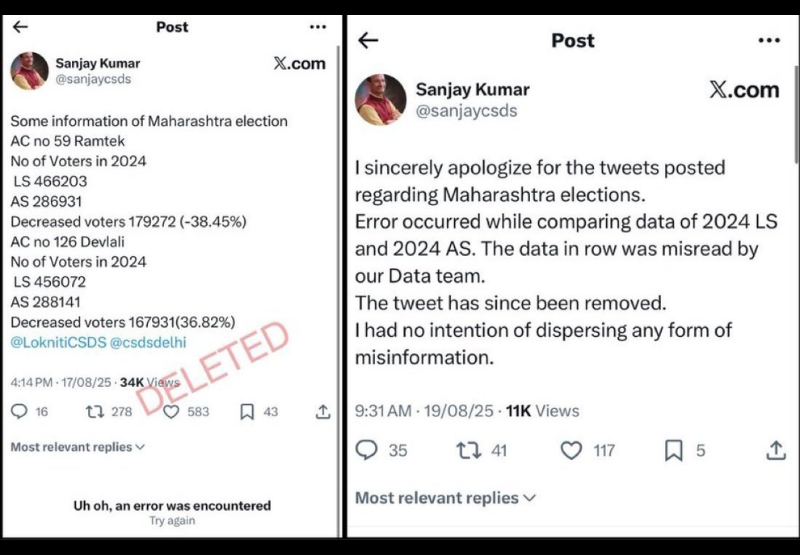
What happened now: Despite his hasty retreat, the political and legal backlash has been swift and damaging for Kumar and CSDS. ICSSR issued a show cause notice against CSDS—for “deliberately scandalising and maligning the reputation and image” of the ECI—and threatened to cancel its funding. The Council flagged specific polling research—including a paper on the ECI’s controversial revision of Bihar’s electoral rolls.
Also this: Two FIRs have been filed by police in Nashik and Nagpur against Kumar:
In both FIRs, Kumar was booked under multiple sections of the Bharatiya Nayay Sanhita (BNS), including Section 175 (false election information), Section 353 (1) (B) (statements conducing to public mischief), Section 212 (false information to a public servant), Section 340 (use of forged documents or electronic records as genuine), and Section 356 (defamation).
On Monday, the Supreme Court stepped in and stayed both the FIRs against Kumar.
But, but, but: Kumar received a reprieve only because he had already apologised and retracted his claims.
The big picture: The government has launched a three-pronged attack on the electoral system in recent years. One: It gutted the independence of the ECI (explained in this Big Story). Two: It has directly targeted researchers like Ashoka University professor Sabyasachi Das—who released a working paper that claimed to show “scientific evidence” of voter manipulation in BJP states (critiqued in this Big Story). Das resigned from his post as the institution distanced itself from the paper. Two other professors also quit and sent an open letter—signed by 87 faculty members—to the university’s Governing Body demanding academic freedom.
And three, the ECI itself has begun tinkering with electoral rolls—right before key elections—disproportionately eliminating women and Muslim voters.
Reading list: BBC News offers the big picture take on the ECI’s credibility woes. The Wire reports on Rahul Gandhi’s ‘atom bomb’ press conference and Sanjay Kumar’s retraction. For more analysis on Sabyasachi Das’ paper, check out this Big Story by Samarth Bansal from 2023.
It’s finally official: Famine has come to Gaza
We’ve known for months that Gazans are being starved to death—as a military strategy of the IDF. But other than human rights groups, global organisations have been slow to sound the alarm. Finally, the Integrated Food Security Phase Classification (IPC)—a UN-backed initiative that monitors global hunger—has issued a report concluding that three key thresholds for famine have been met:
This famine is entirely man-made, it can be halted and reversed. The time for debate and hesitation has passed, starvation is present and is rapidly spreading. There should be no doubt in anyone’s mind that an immediate, at-scale response is needed. Any further delay — even by days — will result in a totally unacceptable escalation of famine-related mortality.
But we knew that, right? Yes, but here’s why the IPC declaration matters:
The IPC, which represents a fastidious survey of available data, is regarded as the international gold standard in nutritional crises. Long-criticised by humanitarians in other emergencies for its overabundance of caution, the IPC’s declaration of Level 5 — “catastrophic” hunger — in Gaza is a significant moment.
The IPC threshold is so high that it has declared only four famines since it was established in 2004—most recently in Sudan last year. A Level 5 finding requires three very specific conditions to be met:
At least 20% of households face "catastrophe," meaning... "an extreme lack of food that ... leads to acute malnutrition and mortality." Second, at least 30% of children under five suffer from acute malnutrition, or wasting. Third, at least two of every 10,000 adults die each day from non-trauma causes.
Data point to note: Right now, a quarter of all Palestinians in Gaza are starving—more than 500,000 people. That number is expected to rise to more than 640,000 within six weeks.
The big picture: No one needs some measuring scale to know that Gazans are dying of hunger. IPC was designed to meet the needs of donor organisations: “It's a mouthful of humanitarian jargon… but it's basically the authoritative, respected, scientific mechanism for measuring levels of hunger in different areas.” It is treated as an authoritative “consensus”—which makes it impossible to ignore or refute.
Reading list: NPR has more on the history of the IPC. The Wire has more details on the report—while The Guardian explains its significance. The IPC report itself can be found here.
Tantrums R Us: Welcome to the Medvedev show!
Daniil Medvedev may not always serve up the best tennis—but his every game is guaranteed theatre. On Sunday, the Russian turned a routine opening round match at the US Open into a late-night circus.
The Anger Games begin: Medvedev faced France’s Benjamin Bonzi—the #51 ranked player who had beaten the #13 ranked Russian in the opening round of Wimbledon this year. In the third set—when Medvedev was facing a match point—a photographer wandered onto the court. Umpire Greg Allensworth allowed Bonzi to replay his first serve—to compensate for this distraction. Medvedev immediately lost the plot—charging to the umpire’s chair, loudly accusing him of “wanting to go home" (Medvedev was two sets down). All of which you can see below.
It gets more nasty: Since no one loves an ugly tennis brawl more than New Yorkers—except when women players are involved (sorry, Danielle Collins)—the stadium was firmly on his side. Medvedev played ringleader, whipping up chants of “second serve.” Charged up by the show of support, Medvedev escalated to this disgusting display—a gesture aimed at Bonzi.
RIP Racquet: No Medvedev show is complete without a racquet sacrifice. After finally losing in five sets, the 2021 champion slumped in his chair—repeatedly smashing his racquet into the bench in frustration. Watch that clip below.
Point to note: While Medvedev’s histrionics aren’t new—the fan support was unexpected. In 2019, he was booed by the crowd, and showed them the middle finger. And in 2023, he argued with the crowd right in the middle of a night match.
The big picture: In the end, the photographer paid the price for Medvedev’s bad behaviour—his credentials have been revoked for this year’s US Open. As for Medvedev himself, he remained unrepentant as always: “What I say and what I do, in my head, I want to do worse, and I cannot because there are rules, because we’re on a tennis court.”
The real reason for Russki rage is his own dismal record. The 2021 US Open champion hasn’t made it past the second round of any major this year, and will now likely tumble out of the world’s top 20. Read BBC News’ profile of him in the build-up to this year’s US Open for more on the enigma. (BBC News)
Japan launches a ‘blue’ power plant
Japan has opened its first “osmotic” power plant—which is expected to generate about 880,000 kilowatt hours of electricity each year—enough to power about 220 Japanese households. This is very cool news—let us explain why.
Wtf is an osmotic power plant? Osmosis is the natural process by which water moves through a permeable membrane to rebalance the concentration of a dissolved substance. In layman words:
Picture a cup divided vertically by a thin, semi-permeable layer — if one side holds salty water and the other side pure freshwater, the water will flow towards the salty side to dilute it, because the salt itself cannot pass through the membrane.
The osmotic power plant leverages that movement to generate electricity:
Osmotic power plants use this same principle, by placing freshwater and seawater on either side of a special membrane, with the seawater slightly pressurised. As water flows across to the saltier side, it increases the volume of pressurised solution, which can then be harnessed to produce energy.
Why this matters: “Blue energy” offers a new kind of renewable source of power:
In contrast to traditional hydroelectric or fossil fuel-based energy generation methods, it does not generate carbon dioxide emissions, making it a clean energy source. What’s more, during the osmotic process water returns to its original environment with minimal ecological impact.
The big picture: According to Earth.org, osmotic energy could satisfy up to 15% of global electricity demand. But, but, but: The tech is difficult to scale—at least right now:
While energy is released when the salt water is mixed with fresh water, a lot of energy is lost in pumping the two streams into the power plant and from the frictional loss across the membranes. This means that the net energy that can be gained is small.
The Guardian has an excellent explainer.
MAP Academy & Nalli Fellowship is now open!!
Editor’s note: As you know, the wonderful MAP Academy is our content partner for Advisory. It is one of the few Indian institutions deeply invested in cultural research and education. They also offer rare funded opportunities for researchers, designers, archivists, journalists, writers and educators. The Nalli Fellowship is one of them.
Over to MAP Academy…
Are you working on the histories and practices of South Asian textiles and their socioeconomic, environmental or cultural implications?
The MAP Academy & Nalli Fellowships is offering four Research Fellowships of Rs 5.5 lakh each, for the study of textiles from India, Pakistan, Bangladesh, Bhutan, Tibet, Afghanistan, Myanmar, the Maldives, Nepal, and Sri Lanka. Applications are welcome from individuals—students, journalists, educators, designers, researchers—as well as from collectives and non-profit organisations. The grant must be used to support one year of research, which may be part of a longer-term project.
Applications will be assessed by an Advisory Committee, based on the responses in the submitted form, which will also double as the project proposal. Shortlisted applicants will be interviewed via an online video call, after which a final selection will be made.
Applications will remain open until October 15, 2025.
Find out more, and apply through this link. For any queries, contact us at: fellowships@map-india.org.

what caught our eye
business & tech
- Perplexity AI has set aside $42.5 million to pay publishers whose articles it uses, as the company—and the wider AI industry—face lawsuits and criticism over misusing their work.
- Elon Musk has announced yet another venture called Macrohard—a “purely AI” software company set up to rival Microsoft. Meanwhile, Elon Musk’s xAI has sued Apple and OpenAI in a Texas federal court, accusing them of rigging App Store rankings to shut out AI rivals.
sports & entertainment
- Grammy-winning rapper and artist Lil Nas X has been arrested and hospitalised in LA for roaming the city nearly nude.
- Rejoice, ‘KPop Demon Hunter’ fans! The theatrical release of the Netflix movie has been a massive success across North America—making it the first movie from a streamer to hit #1 on the big screen.
- Stylist has a good read on why Millie Bobby Brown’s fertility and her suitability to be a mother at 21 will never be acceptable by the society.
- Wall Street Journal (splainer gift link) has a good read on how the Goo Goo Dolls’ 1990s hit 'Iris' has turned into Spotify’s song of the summer.
health & environment
- Say hello to the newest fitness trend: ‘clear' protein—a protein powder or pre-bottled shake that’s not chalky, milky or grainy.
- BBC Culture looks at what foods are good for a good night’s sleep. Yup, this includes the age-old Indian trick where kids are given milk before bed.
- A new Indian Council of Medical Research report found that breast and cervical cancers are the most common types of cancers among Indian women, while oral and lung cancers dominate among men.
- Just two years of heat wave exposure can speed up biological aging by up to 12 days, with scientists warning the impact builds over time.
meanwhile, in the world
- Moody’s chief economist Mark Zandi warns the US is on the brink of recession, blaming high tariffs and strict immigration policies—with some states already feeling the squeeze.
- One of the strongest typhoons in decades has slammed into central Vietnam, uprooting trees, destroying homes and forcing more than 300,000 people to evacuate.
- The world’s safest countries—ranked for peace, stability, and low conflict—are Iceland, Ireland, New Zealand, Austria, and Switzerland.
meanwhile, in India
- The Telegraph has a good read on how new roads in Uttarakhand’s Chamoli district, instead of bringing progress, have stirred fear and superstition, with villagers turning to an old pilgrimage to appease the gods against rising landslides.
- The Supreme Court has directed 'India’s Got Latent' host Samay Raina and his four co-comedians to issue an unconditional apology on their show or podcast for mocking people with disabilities and rare genetic disorders.
Three things to see
One: Non-stop rainfall on Sunday in Rajasthan’s Sawai Madhopur district caused the Surwal Dam to overflow into the fields—submerging hundreds of homes across a dozen villages. It also created a gaping 2 km-wide crater. You can see the spectacle below. (Economic Times)
Two: Researchers have discovered a new bat species in Uttarakhand—the Himalayan long-tailed Myotis (Myotis himalaicus)—which has a tail almost as long as its body. Myotis is one of the largest and most common of bat species, comprising more than 100 species worldwide. Mongabay has lots more on Indian bats.

Three: This is the trailer for ‘Songs of Paradise’—a tribute to the Melody Queen of Kashmir, Raj Begum—who was a household name in the 1950s. Directed by Danish Renzu, the singer is portrayed by Saba Azad in her younger years and Soni Razdan as she ages. The Print has more on this legendary singer. The film drops this Friday on Amazon Prime.
feel good place
One: Why Trump was born to be gay… lol!
Two: Mumbai hair.
Three: Us next week minus splainer. Depressed? Relaxed? But definitely in bed lol!
 souk picks